
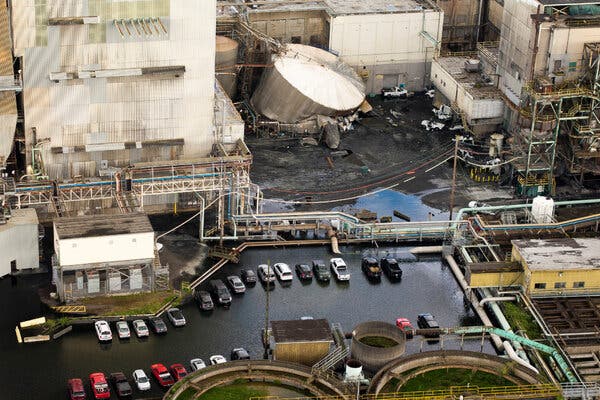
Authorities announced that the bodies of two workers missing after an explosion at a Washington State paper mill were recovered on Saturday. This brings the death toll from the incident to 11.
The explosion occurred on Tuesday morning at the Nippon Dynawave Packaging plant in Longview, Washington. A tank holding 600,000 gallons of a caustic chemical known as ‘white liquor’ ruptured, causing the blast. The chemical is used to process wood chips into packaging board, primarily for juice cartons.
Initially, two fatalities were confirmed, with nine workers reported missing following the incident. The recovery of the missing workers was challenging due to hazardous conditions at the site. Recovery teams needed special protective gear and decontamination procedures to safely navigate the area.
This work has been intense and methodical, demanding great effort from everyone involved,said Kurt Stitch, deputy chief of Cowlitz 2 Fire & Rescue.
By Thursday, seven of the missing had been located. The final two bodies were found on Saturday after extensive searches through the debris-strewn facility.
Cowlitz County Coroner Dana Tucker confirmed the identities of the deceased. They included Gilbert Bernal (52), Tyler Covington (29), Brad Covington (27), Robert Wilson (48), Dale Miller (54), Jared Ammons (35), Braydon Finkas (38), Clinton Doran (26), John Forsberg (51), Norman Barlow (58), and Dillon Miller, whose age was not provided.
At the time of the explosion, the workers were in an area where assignments were given for the day. The paper mill has been a key employer in the region, though industry changes have impacted similar facilities nationwide.
Nippon Dynawave is cooperating with investigations into the cause of the explosion. The incident has sparked questions regarding the plant’s future and its impact on the local economy, as it employs approximately 550 workers.
Environmental officials from federal and state agencies have monitored the site since the explosion. They have assured the public that drinking water remains safe, though they advised against contact with waterways linked to the contaminated storm drainage system.
Authorities expressed minimal concern over contamination of the Columbia River, given its vast size and capacity to dilute potential pollutants.