
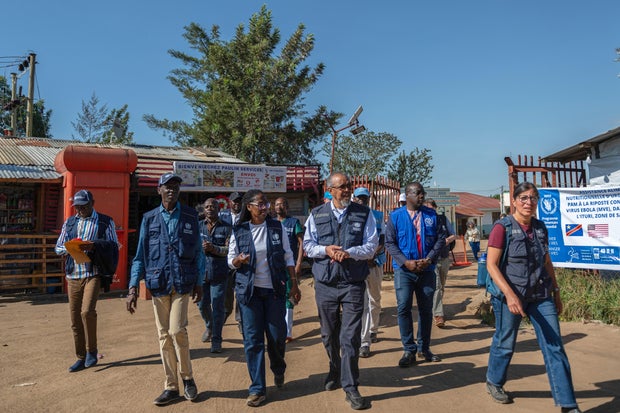
The World Health Organization (WHO) Director-General, Tedros Adhanom Ghebreyesus, announced that five individuals have recovered from a rare form of Ebola. This highlights the importance of seeking treatment when symptoms appear. Although there is no approved treatment or vaccine for the Bundibugyo virus responsible for the outbreak, recovery remains possible, as these cases show.
During a visit to a new Ebola treatment center in Bunia, Congo’s Ituri province capital, Tedros noted, “Four people will be discharged today and there was one that was discharged the day before yesterday.”
Despite continued efforts to develop vaccines and treatments, Tedros emphasized, “People can recover from Ebola.” At present, Congo reports 906 suspected cases and 223 deaths, with 134 confirmed cases and 18 deaths in Congo and adjacent Uganda. Uganda itself has confirmed nine cases and one death.
“The virus spreads faster than the response,” noted Doctors Without Borders (MSF), urging rapid expansion of testing and aid worker deployment.
Local health workers face challenges from residents’ anger over strict medical protocols, conflicting with traditional burial customs. Multiple health center attacks have occurred.
Addressing community involvement is vital, Tedros stressed. “Early engagement with health facilities upon noticing symptoms can result in recovery,” he added, urging collective action.
Response efforts face further obstacles due to regional conflicts; Ituri encounters disruptions from Allied Democratic Forces, linked to the Islamic State group, and ethnic militias. Additional cases appear in North Kivu and South Kivu, controlled by Rwanda-supported M23 rebels.
Hope remains, stated Pierre Akilimali from Congo’s National Institute of Public Health. “With symptomatic treatments, patient recovery is evident,” he noted.
Davin Ambitapio, a physician at the treatment center, expressed optimism, saying, “The virus here is less complex than previous strains, and with partner support, we aim to control the outbreak swiftly.”