
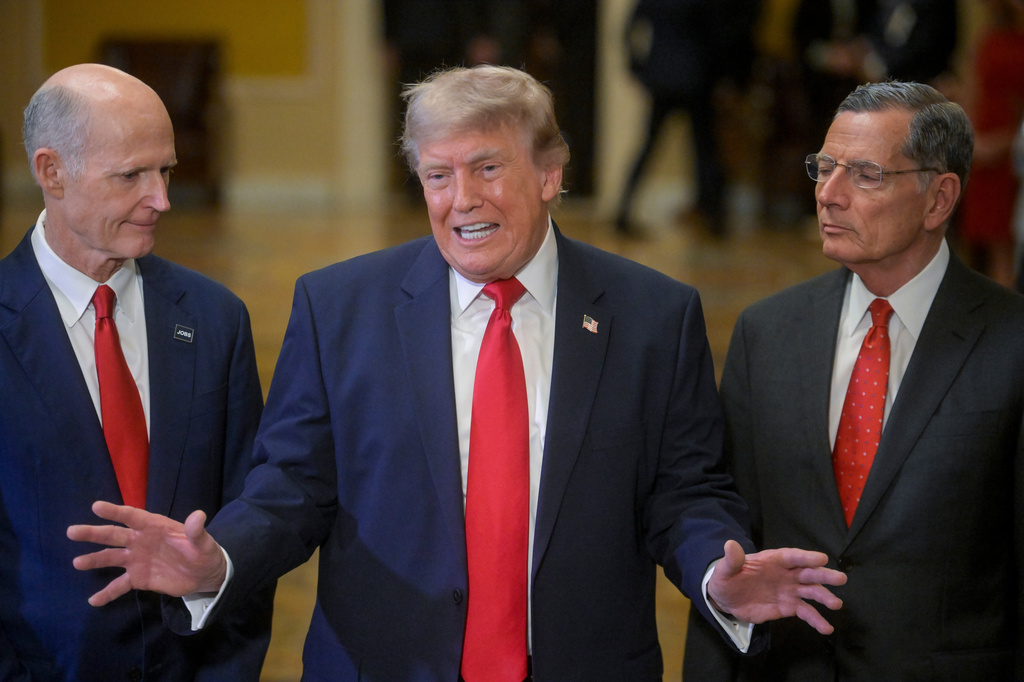
President Donald Trump recently attended a closed-door lunch with the Senate Republican Conference. During this meeting, he criticized four GOP senators who had supported a House resolution restricting U.S. military actions against Iran. These senators were Susan Collins, Bill Cassidy, Lisa Murkowski, and Rand Paul. The resolution was passed by the Senate with a 50-48 vote.
Trump questioned why any senator would endorse the war powers resolution. Senator Bill Cassidy, having lost his primary to a Trump-endorsed challenger, responded defensively. He accused the president of failing to inform the public adequately and criticized the prolonged military mission. This exchange led to a heated argument between the president and Cassidy.
The Trump administration claims the resolution is unconstitutional, citing the 1983 Supreme Court decision in Immigration and Naturalization Service v. Chadha. This ruling stated that any legislative measure must pass both houses and be presented to the president for approval or veto. In the Chadha case, a legislative veto provision was struck down as unconstitutional.
Traditionally, the Supreme Court avoids engaging in foreign policy disputes between government branches, which it views as political questions beyond its jurisdiction. This has allowed for the continued use of the 1973 War Powers Resolution permitting concurrent resolutions to cease military actions without presidential approval.
After tensions eased, Senator Tim Kaine proposed a joint resolution requiring presidential consent, aiming to halt further military involvement in Iran. However, Cassidy voted against it, and Paul opted to vote “present.” The motion was rejected with a 47-50 vote.
Simultaneously, the Senate wrestled with President Trump’s demand for an immediate vote on the SAVE America Act related to election law changes. In exchange for passing this act, he agreed to consider a separate housing affordability bill. Nevertheless, the election law changes lacked sufficient support, prompting the Senate to adjourn early for a two-week recess.
Additionally, Trump delayed the confirmation hearing of his director of national intelligence nominee, Jay Clayton. He insisted the Senate first confirm Clayton’s successor as U.S. district court attorney for the Southern District of New York. This bargaining method, where bills and nominations face delays pending other priorities, has disrupted Senate scheduling.
This tactic has frustrated congressional leaders, complicating their planned schedules. It recalls the 1941 movie, “The Man Who Came to Dinner,” but this time it was “the president who came to lunch,” dictating not only the meal but also the order of courses. Such interventions have proven difficult for Congress to manage.
Don Wolfensberger, a former congressional staff veteran who served as chief of staff of the House Rules Committee in 1995, provides insight into these developments. His work includes “Congress and the People: Deliberative Democracy on Trial” and “Changing Cultures in Congress: From Fair Play to Power Plays.”