
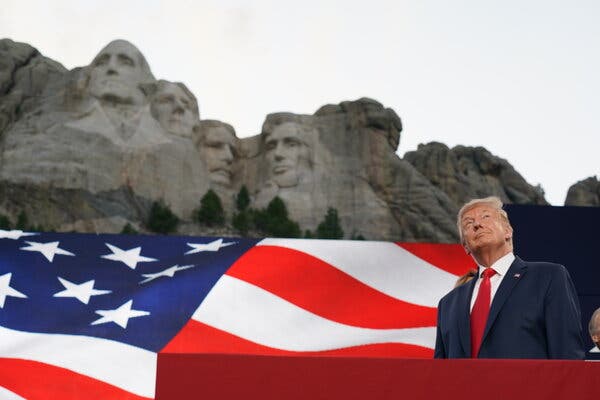
On the evening of July 3, President Trump spoke at Mount Rushmore on the eve of the United States’ 250th birthday. His address served not only to extol the nation’s founders but also to vigorously criticize his political opponents as ‘communists.’ This appeared to be a prelude to the upcoming November midterm elections.
With just four months left before significant midterms, President Trump used the iconic backdrop to cast his opponents as ‘godless’ and ‘evil’ communists. He emphatically warned that losing the midterms was only possible through foolishness and urged Congress to enact his SAVE America Act. This legislation proposed more stringent voter ID rules, aimed at making voting more challenging. Trump also called for ending the filibuster.
The motive behind Trump’s rhetoric was clear: countering a growing progressive movement within the Democratic Party that was gaining traction among liberal voters. His speech highlighted a consistent narrative used by the White House to fend off this challenge.
Trump’s speech painted a doomsday picture as the likenesses of Washington, Jefferson, Roosevelt, and Lincoln witnessed the event. He repeated the word ‘communism’ frequently, evoking memories of the Cold War. His message was direct, claiming communism as the adversary of American independence, even dubiously labeling it a greater threat than historical events like Pearl Harbor and 9/11. Karl Marx was specifically mentioned in this context.
Despite the charged rhetoric, Trump’s speech began on a more positive note. He celebrated the United States as the pinnacle of civilization, asserting that Americans live in a uniquely special country. His initial remarks resonated with the audience, who responded enthusiastically.