
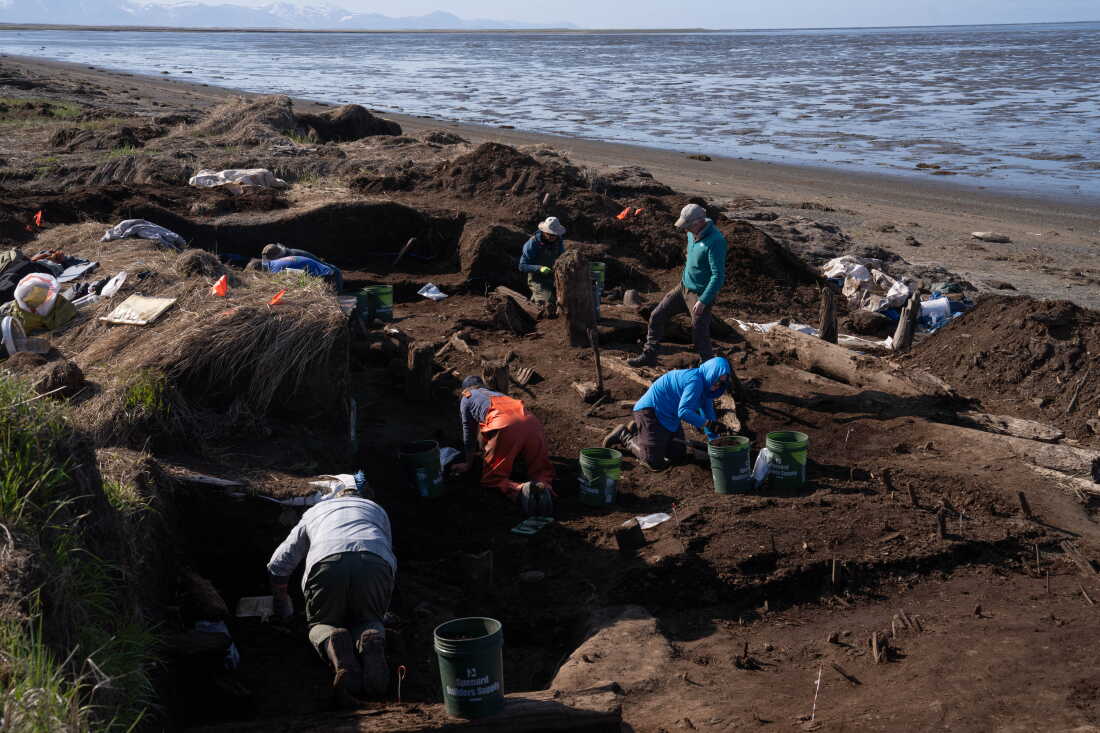
A dedicated team of volunteer excavators and archaeologists tirelessly uncovers artifacts at the Nunalleq dig site, situated near Quinhagak, Alaska. This initiative gained urgency last October when remnants of Typhoon Halong swept through western Alaska, resulting in widespread flooding and displacing over a thousand individuals from remote villages. Among the affected areas, Quinhagak experienced significant damage to homes and infrastructure.
Jenny Matthew, a local resident, vividly recalls exploring the battered beach with her husband on four-wheelers, assessing the storm’s impact. As they examined the debris, a distinctive wooden bowl caught their attention. It was carved by Quinhagak residents between 400 and 600 years ago and was part of a vast collection of cultural objects unearthed by the storm from the Nunalleq site, a renowned repository of Alaska Native Yup’ik culture before Western contact.
The storm not only scattered many artifacts but also heightened risks for those still buried. The erosion of the land buffer between the Bering Sea and the dig site increased the vulnerability of these historical items. In response, archaeologists organized an emergency excavation to salvage as much as possible before the next major storm.
Since 2009, archaeologists have worked at Nunalleq to preserve historical artifacts. Rick Knecht, the lead archaeologist, shares that after thawing permafrost revealed many artifacts in the early 2000s, the village decided to rescue these cultural treasures. The site includes hand-carved animals, grass ropes, sewing needles, wooden masks, and kayak pieces.
The frozen ground has notably preserved artifacts composed of organic materials that might otherwise erode under different conditions. The team, primarily volunteers, operates with modest funding from groups like the Pacific Northwest Archaeological Society and the Daughters of the American Revolution. Although the entire site spans two Olympic-size pools, current emergency efforts focus on an area equivalent to a backyard pool, encircling remnants of sod houses from 400 to 500 years ago.
Charlotta Hillerdal, an archaeologist involved for over 15 years, was deeply affected when she learned of the storm’s impact while in Scotland. The threat to the site persists as the Bering Sea encroaches due to decreased sea ice and thawing permafrost, consequences of human-induced climate change. The October storm further closed the gap, with seawater reaching the dig site during high tides.
After the storm, extensive flooding covered the site, sweeping away many valuable items. The looming possibility of recurrence fuels the archaeologists’ resolve to continue excavation. Rick Knecht asserts their commitment to prevent these artworks from being claimed by the sea again.
Preserving these artifacts is crucial not only for historical remembrance but also for the Quinhagak community. The Nunalleq Culture and Archaeology Center offers a museum-like setting where descendants and the public access Quinhagak’s past. Elizabeth Church, director of Quinhagak Heritage Inc., emphasizes the importance of stewardship over their ancestors’ belongings, noting the trauma caused by seeing artifacts strewn across the beach.
Church highlights the profound connection between the community and these artifacts, underscoring their resilience and adaptability to environmental changes. As fall storm season approaches, urgency grows to salvage what remains of this rich cultural heritage.