
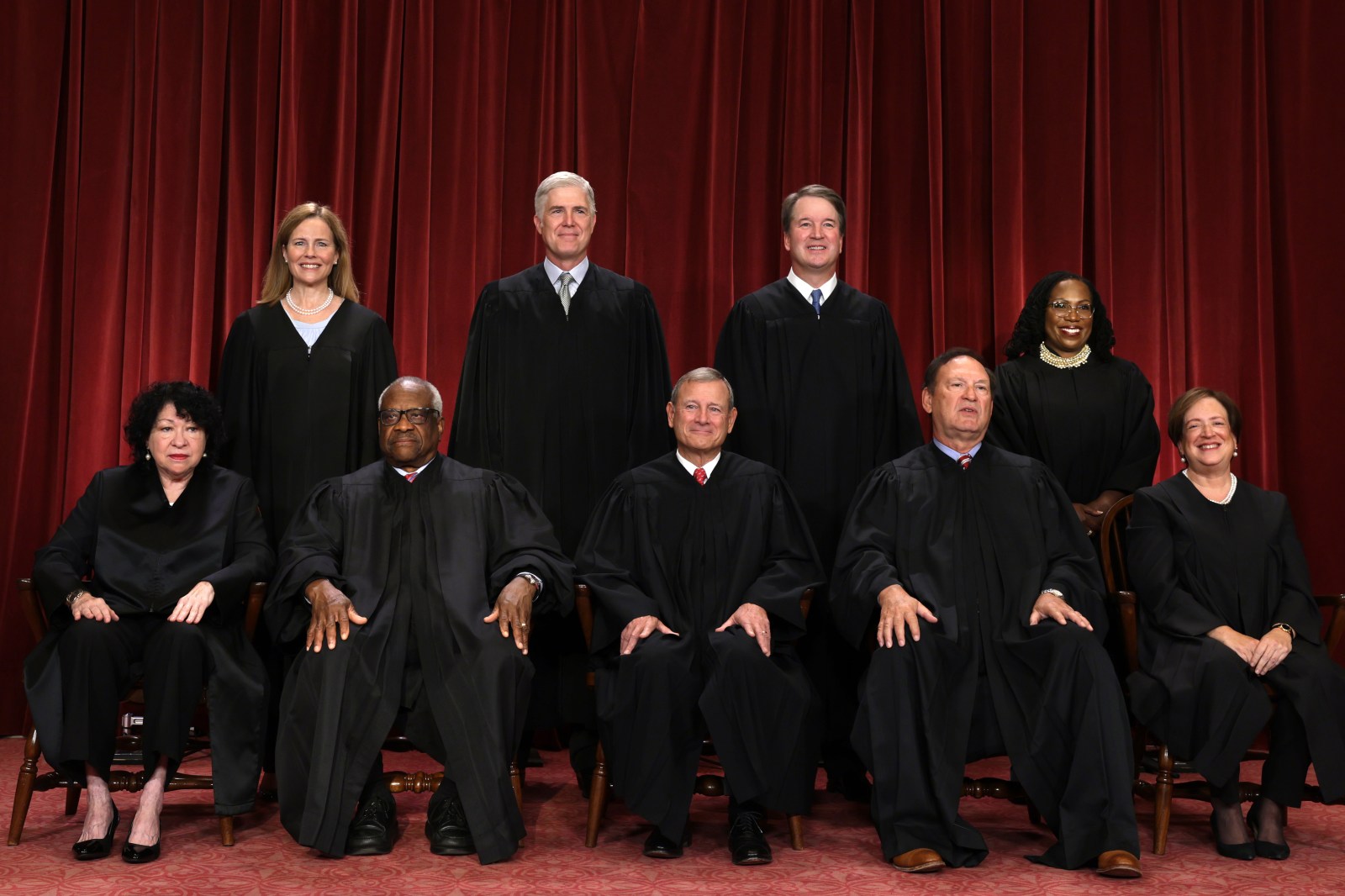
The perception of several conservative Supreme Court justices has become more negative in the past year, according to a new national poll. The poll, conducted by YouGov/The Economist, reveals a downturn in the favorability ratings of Justices Clarence Thomas, Amy Coney Barrett, and Brett Kavanaugh, when compared to a similar survey conducted the previous year. Of the three, Barrett experienced the largest decrease, with a rise in ‘very unfavorable’ ratings.
Justice Brett Kavanaugh witnessed a minor shift of -2 in net favorability, as did Chief Justice John Roberts. These changes occur alongside a general decline in the approval of the Supreme Court as a whole.
Public’s View of the Supreme Court
The ongoing skepticism toward the court is evident in the survey results. Public opinion remains sharply divided along partisan lines. Democrats are notably more critical of the conservative justices, whereas Republicans maintain a more positive view.
The poll indicates that the Supreme Court’s approval rating stands at 36 percent, with a disapproval rating of 50 percent. It highlights that 44 percent of respondents perceive the court as ‘too conservative,’ while 9 percent find it ‘too liberal.’
This survey was conducted in the context of recent high-profile decisions concerning birthright citizenship and presidential power. When questioned about the court’s impact on presidential power, 45 percent of respondents believed the court has granted too much power to the president, 29 percent thought the balance was adequate, and 9 percent felt there was insufficient power.
The poll surveyed 1,603 U.S. adults between July 3 and July 6, with a margin of error of 3.3 percent.
Favorability Ratings Breakdown
Chief Justice John Roberts, appointed by George W. Bush, has a 25 percent favorability rating, with a 36 percent unfavorable rating. Last year, his favorability was slightly higher at 27 percent, leading to a net approval of -11 percent this year compared to -9 percent last year.
Justice Brett Kavanaugh’s favorability is at 27 percent, with a 37 percent unfavorable rating. Previously, his favorability was at 31 percent with a 39 percent unfavorable mark, resulting in a net approval of -10 percent this year compared to -8 last year.
Justice Neil Gorsuch saw a slight improvement, with a current favorability of 23 percent against a 30 percent unfavorable rating. This marks a -7 percent net favorability this year, an improvement from the -8 percent last year.
Justice Elena Kagan, appointed by Barack Obama, has a favorable rating of 30 percent, with a 24 percent unfavorable rating, netting a positive favorability of 6 percent. Last year, her net favorability was negative at -3 percent.
Justice Sonia Sotomayor’s favorability is 37 percent to a 26 percent unfavorable mark, with a net 11 percent favorability. Last year, she had a net 4 percent favorability.
Justice Samuel Alito holds a 25 percent favorability against a 32 percent unfavorable rating, with a -7 percent net favorability. Last year’s net approval was -6 percent.
Justice Amy Coney Barrett’s ratings are 23 percent favorable to 38 percent unfavorable. Her net favorability of -15 percent is a notable decline from last year’s -9 percent.
Justice Clarence Thomas shows a 29 percent favorability with a 41 percent disapproval, resulting in a -12 percent net approval. This reflects a drop from last year’s -9 percent.
Justice Ketanji Brown Jackson, appointed by Joe Biden, has improved her net favorability to 8 percent. Her favorability rating is at 34 percent compared to a 26 percent unfavorable rating, up from a 2 percent net favorability last year.
Analyst Insights
Dave Aronberg, former State Attorney for Palm Beach County, commented that the decrease in favorability is not linked to a single ruling or president. He emphasized the perceived politicization of the court, citing decisions that have influenced public opinion unfavorably. Aronberg mentioned that Justice Barrett’s decisions have displeased people on both sides of the political spectrum.