
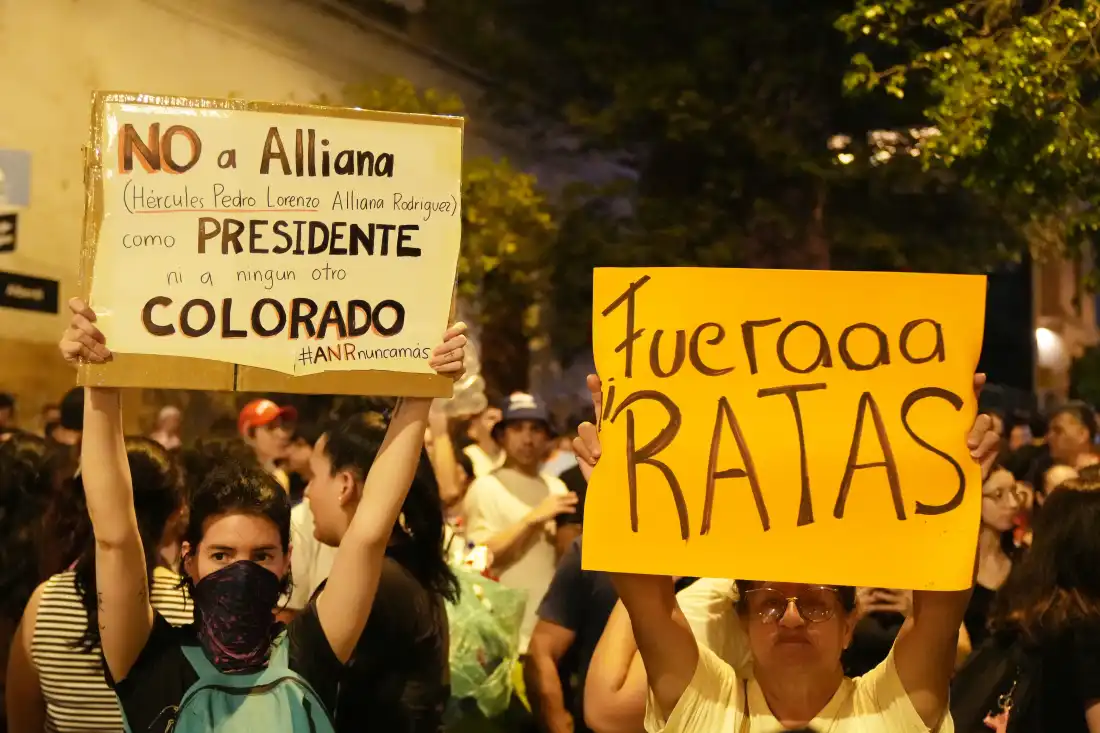
Protesters recently assembled outside Congress in Asunción, Paraguay. Their dissatisfaction stems from the impeachment and removal of President Santiago Peña, linked to the collapse of Ueno Bank. Following this, Vice President Pedro Alliana was sworn in as the new leader.
When Ueno Bank’s operations ceased early on a Tuesday morning, the impact on Paraguayans relying on the bank for daily transactions was swift. “People no longer trust,” stated Elizabeth González, a barista in downtown Asunción. Customers showed reluctance to trust banking institutions, as evidenced by their preference for cash payments.
The collapse affected not only the bank’s shareholders but the broader public as well. Ueno Bank claimed to have 2.9 million customers, approximately 60% of Paraguay’s adult population. The Central Bank noted that 1.8 million were depositors. By the following Saturday, 1.2 million had received advance payments via the state’s deposit guarantee fund, yet many awaited resolution.
Responses to this crisis catalyzed political upheaval. Peña, a close ally of former U.S. President Donald Trump, faced intense scrutiny. The anger was evident outside Congress with protesters holding him accountable for the bank collapse.
Voices like Elodia Saveredo, a 71-year-old housewife, expressed collective frustration. Meanwhile, students like Batarram Caballero highlighted the economic strain on peers who depended on their funds for basic needs.
Ueno Bank began as a fintech in 2021, transitioning to a bank in 2023. It rapidly gained prominence due to digital convenience and lucrative incentives. However, a promotional blitz before the bank’s collapse sparked concerns about its sustainability.
The bank’s involvement with public funds added complexity. The Social Security Institute had invested around $355 million in Ueno, raising questions about how such a nascent bank managed significant public investments. Economist Manuel Ferreira criticized the bank’s asset management, noting troubling transactions benefiting the controlling owners, Grupo Vásquez.
Complications arose as Peña’s ties to Ueno’s holding company became public. He held shares valued at approximately $845,000 even after assuming the presidency. Allegations surfaced that he directed public deposits to Ueno, leveraging his position for personal gain.
Following his resignation, Peña was charged with breach of trust and detained during investigation proceedings. The allegations also enveloped Carlos Carvallo, Central Bank head, along with Ueno executives including CEO Miguel Vásquez.
The scandal directed attention to Horacio Cartes, a former president, who once supported Peña politically. Their relationship fractured amidst Peña’s efforts to build independent influence. Post-collapse, Cartes distanced himself and backed impeachment proceedings against Peña.
For many outside Congress, the scandal signifies broader discontent with Paraguay’s political framework. Activist Rodrigo Piatti emphasized that addressing these systemic issues demands substantial political change.
Concerns extend to Paraguay’s international reputation. Exporter Eduardo López highlighted growing skepticism about Paraguay’s governance among foreign businesspeople.
Lizza Lugo, a student leader, criticized legal inequalities and urged citizens to seek transformative political solutions in future elections.