
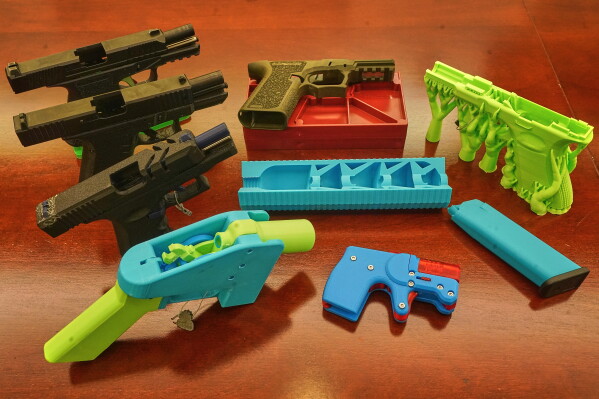
New York introduced a pioneering law that could mandate 3D printers sold for household and business use to include technology to prevent the production of guns. This initiative, also under review in California, aims to counter the emerging method of creating untraceable ‘ghost guns’ that have been linked to criminal activities. However, questions arise about the effectiveness of the technology and its implications for personal privacy and constitutional rights.
Currently, roughly one-third of U.S. states have measures to ban or control homemade firearms without serial numbers, which bypass background checks required for purchases from federally licensed dealers. What sets this new effort apart is its focus on the machinery used to manufacture these weapons, rather than targeting the individuals who produce them. The proposed technology in these states could establish industry standards for 3D printers and act as an example for other states aiming to strengthen gun control. These states often already have regulations against certain semi-automatic weapons and can temporarily confiscate firearms from those deemed a risk.
The Rise of Privately Made Guns in Crimes
Since becoming more prevalent over the past two decades, three-dimensional printers have surged in numbers worldwide, climbing from about 30,000 in 2012 to over 3 million today, as noted by Bill Decker, executive chairman of the Association of 3D Printing. While high-end models are expensive, some 3D printers are available for several hundred dollars. These devices can produce a wide array of items, from toys to prosthetic limbs and airplane parts, and they can also manufacture firearms using online digital designs.
Firearms crafted with 3D printers, often called ‘ghost guns’ due to their lack of serial numbers and traceability, are being increasingly used in crimes, according to a U.S. Department of Justice report. The number of privately made guns connected to crimes and submitted to federal authorities rose significantly from around 1,600 in 2017 to nearly 27,500 in 2023. In some cases, such as a high-profile New York incident, a 3D-printed gun was suspected in the murder of UnitedHealthcare’s CEO in 2024.
Technological Measures to Prevent Gun Parts Production
New York’s recent law, combined with a similar bill in California, proposes forming expert panels to create standards for firearm blueprint detection algorithms. Such technology would review every design for 3D printing, compare it to a database of firearm parts, and block production of those that resemble weapons. Though development is underway, mandatory firearm blocking technology for 3D printers in New York would not start until 2029 or potentially later if deemed unfeasible.
The proposed technology functions similarly to smartphone apps that identify plant species from photos. For 3D printers, it would employ geometric analysis to differentiate shapes, dimensions, and other structural features, thereby rejecting projects resembling firearm parts. Julian Chultarsky from Physna, a tech company specializing in this technology, asserts that geometric search is ready to tackle this challenge.
Potential Concerns and Limitations
While supporting the legislation in New York and California, the Association of 3D Printing expresses skepticism about its efficacy, viewing it more as a political gesture. Criminals could still modify designs or relocate their printing activities to circumvent regulations. Rory Mir from the Electronic Frontier Foundation highlights risks such as unintended blocking of non-weapon items and privacy concerns over cloud-based AI searches.
These types of censorship algorithms might inadvertently block lawful creations, according to Mir. For example, harmless items like pipes could erroneously resemble gun parts. Furthermore, the submission of print instructions to cloud-based platforms poses a threat to the privacy of artistic and proprietary works.
The Debate Over Constitutional Rights
Gun safety advocates argue that 3D printers provide a route for individuals unable to legally purchase firearms, such as minors or felons, to obtain them. Currently, eleven states prohibit 3D-printed guns, and six require serial numbers for them, based on information from Everytown for Gun Safety. Preventing the 3D printing of firearms could enhance compliance with such laws.
Samuel Levy from Everytown for Gun Safety calls 3D printing a significant battlefield in tackling ghost guns. However, the National Rifle Association disagrees, citing homemade firearms as a long-standing American tradition. John Commerford from the NRA Institute for Legislative Action contends such regulations unjustly restrict law-abiding Americans’ constitutional rights.