
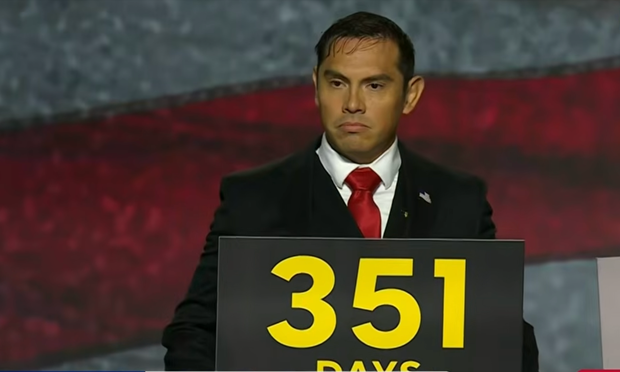
An active-duty Navy sailor, who was imprisoned in Venezuela for nearly a year before being released in a prisoner exchange under the Trump administration, appeared at the Republican National Committee’s midterm convention. This has sparked discussions about the military’s enforcement of rules to keep active-duty personnel out of political activities.
Petty Officer’s Appearance
Petty Officer 2nd Class Wilbert Joseph Castañeda appeared at the GOP event in Dallas, not in military uniform but in a black suit and red tie. He was among others on stage who held signs, showing the number of days they were detained. His sign read “351 days” to indicate his time held in Venezuela.
A RNC announcer introduced the former hostages as those taken during the Biden administration and freed by Trump in the previous year. Castañeda’s presence on stage challenges military policies that restrict active-duty members from participating in partisan events, even if not in uniform.
Military Regulations
The Defense Department has rules prohibiting active-duty troops from engaging in partisan political rallies and conventions. Troops can attend as spectators if not in uniform, as outlined in Defense Department Directive 1344.10. Violation of this directive may result in charges for disobeying orders.
Cody Harnish, a private defense attorney and former Army Judge Advocate General officer, noted the policy’s clarity: being a “spectator” is different from being a “participant.” Castañeda’s presence on stage signaled participation, not mere attendance.
Background and Military Career
Castañeda’s military career has drawn attention previously. Enlisted in 2007, he became a Navy SEAL and earned several accolades. His service details and history were shared by the Navy, noting his participation in special warfare units across the U.S. In 2024, Castañeda was detained in Venezuela, accused of involvement in a coup before the claim was retracted due to lack of evidence.
He was among ten Americans released from Venezuela through a diplomatic exchange. His family described him as a political pawn, mentioning traumatic brain injuries affecting his decisions.
Contrasting Cases
While Castañeda’s case garners media attention, other service members face related issues. Air Force Maj. Jason Watson, who criticized Trump, faces charges under the Uniform Code of Military Justice. Comparisons arise between Watson and former Marine Stuart Scheller, who faced charges after releasing critical videos during the Biden administration.
Scheller pleaded guilty to charges, continuing his career at the Defense Department. His attorney, Tim Parlatore, now advises the defense secretary.
Military courts and regulations emphasize remaining apolitical, underscoring the importance of separating the military from partisan political activity. This neutrality is vital to maintaining public trust in the armed forces.
The situation underscores ongoing debates over the intersection of military duty and political involvement.