
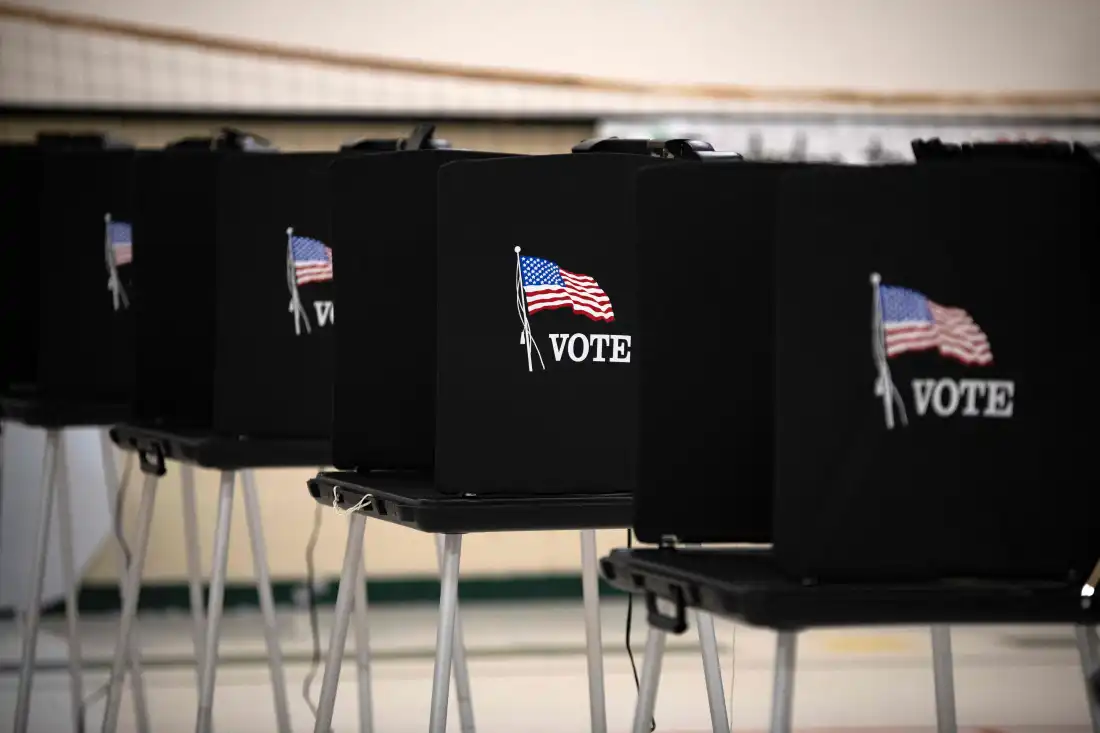
Voting booths at Glass Elementary School’s polling station in Eagle Pass, Texas, were active on November 8, 2022. The sight of people casting votes marks a crucial element of democracy. Currently, a national initiative aims to ensure that the president is elected by the popular vote. This effort is approaching an important phase due to significant Democratic victories in the recent midterm elections.
Next year, Democrats will hold full control in five states, possibly paving the way for them to join the National Popular Vote Interstate Compact. This compact is an agreement where states allocate their presidential electoral votes to the candidate who wins the nationwide popular vote. Presently, 18 Democratic-led states, along with the District of Columbia, have joined the compact. If the new states participate, the effort will achieve the 270 electoral votes needed to bypass the Electoral College.
Republican-led states remain absent from the compact, and the party lacks a unified stance on the matter. Yet, proponents believe many of the political, practical, and legal barriers will be overcome, potentially by the next presidential election.
Patrick Rosenstiel, a senior consultant to National Popular Vote, expressed optimism. “I’ve never been more confident that 63% of American voters can get what they want in the 2028 presidential election,” he stated, referencing Pew polling. Currently, the compact has secured 222 electoral votes. The five states under complete Democratic control—Arizona, Pennsylvania, Michigan, Nevada, and Wisconsin—comprise 61 electoral votes. If most join, the compact will surpass the 270-vote threshold.
Governors in Pennsylvania and Nevada have shown openness to joining the compact. Other governors have yet to make public decisions. States like these, pivotal in presidential elections, face the tough decision of whether to forfeit their election influence or become key players in a significant change to the U.S. electoral process.
Democratic Arizona Gov. Katie Hobbs has not recently commented on her stance, despite earlier support. NPR reached out to Hobbs’ office for a response, but received none before publication.
The Legal and Practical Challenges
Legal scholars suggest potential conflicts with the Constitution’s compact clause. This clause restricts states from forming agreements without congressional consent. Norman Miller, a constitutional law professor at Willamette University, highlighted potential issues, noting that this compact could alter decentralized presidential elections. Each state currently has the autonomy to determine its own voting processes. Enforced compliance across states might lead to conflict.
Miller emphasized the need for standardized voting rules managed by a federal authority. “Using 51 separate election administrators for a national election would breed mistrust and division,” he noted.
John Koza, chairman of National Popular Vote, contended that the compact wouldn’t require centralized oversight. “State and federal laws ensure certified vote counts from each state, which merely need summing,” he explained.
Miller believes that altering the Electoral College requires a constitutional amendment. Previous attempts to eliminate it, such as in 1969, failed. He argues for a thorough amendment process under Article 5.
The Future of Electoral Reform
Rosenstiel understands the amendment challenges and advocates for inventive solutions. “We aim to resolve an issue most Americans perceive,” he remarked. He anticipates that a national popular vote would require candidates to address the nation as a whole, rather than cater to battleground states alone. This change, he claims, would ensure every voter’s significance.
“Every American voter should feel valued. Only one reform guarantees it,” Rosenstiel concluded.