
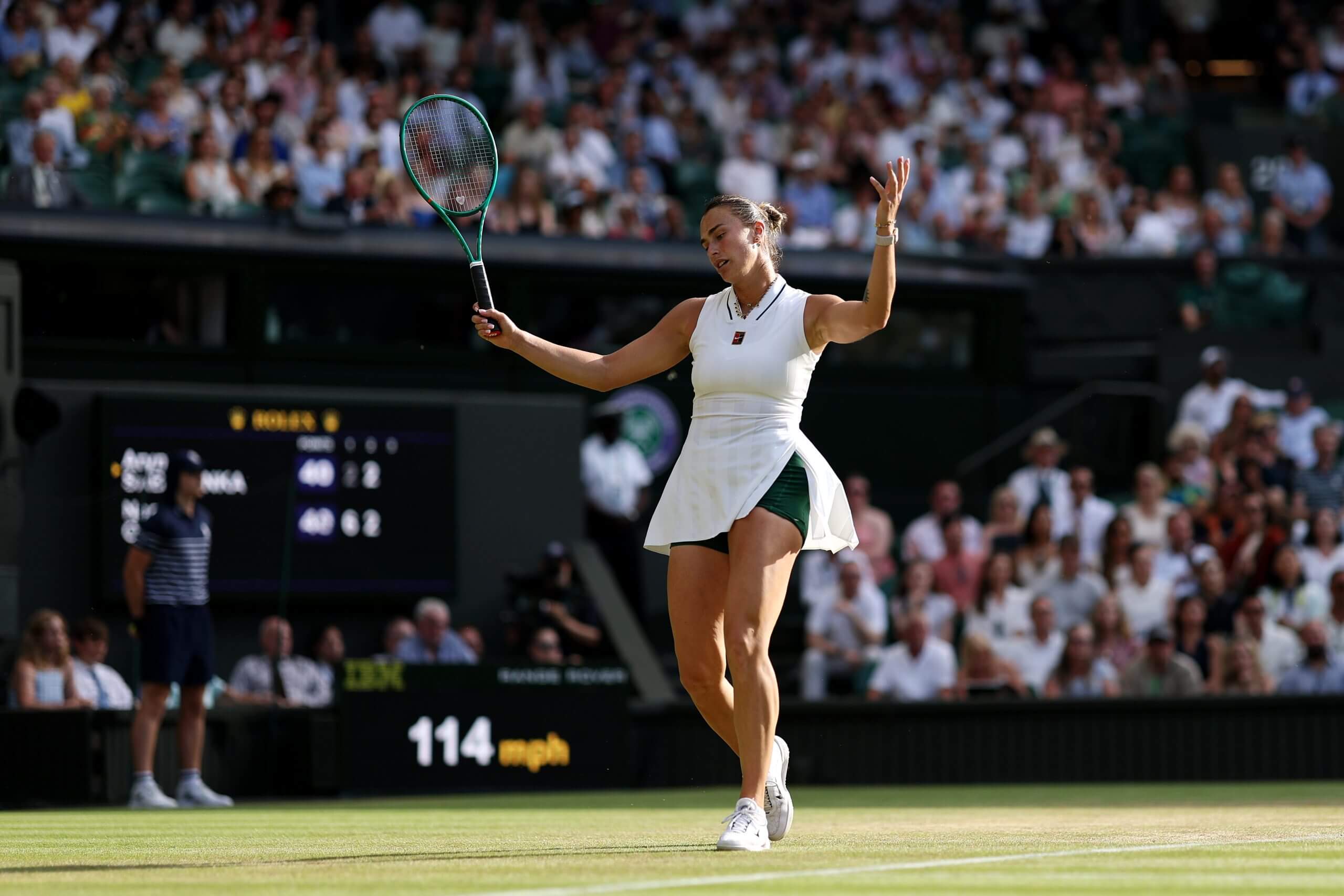
Naomi Osaka demonstrated a powerful display of tennis prowess at the All England Club, taking a significant step in her grass-court performance. On a warm evening in London, she defeated Aryna Sabalenka in straight sets, marking her advance to the Wimbledon quarterfinals for the first time.
Osaka’s Unmatched Performance
Osaka’s commanding victory was characterized by her dominant serve and precise groundstrokes, which kept Sabalenka struggling. With a final score of 6-2, 7-6(2), Osaka achieved her most notable win since her return to the tour post-pregnancy in 2024. This success also stands as her most significant since her last Grand Slam victory in February 2021.
Osaka’s returning to form speaks volumes about her adaptability and skill on grass courts, surfaces she once found challenging. Her serve was particularly impressive. In the second set, she successfully landed 70% of her first serves, winning 22 of the 23 points on those serves and 87% overall. Her second serve was equally effective.
Sabalenka’s Summer Struggles
For Sabalenka, the match reflected continued difficulties in a season that began strong with a final appearance at the Australian Open and Sunshine Double victories in Indian Wells and Miami. Transitioning to clay and grass, she found it challenging to maintain her early success. This pattern was evident during her quarterfinal encounter at the French Open, where she lost her form after leading against Diana Shnaider.
“I wasn’t really thinking about my record at all. I was just trying to focus point by point,” Sabalenka stated. “What could I do if the person is acing and hitting the lines, just going for her shots without any fear?”
Nonetheless, Osaka’s strategy and execution made her formidable opposition. Even an optimal version of Sabalenka would have struggled under Osaka’s pressure.
Surpassing Expectations
Both players, aged 28, typically show strengths on grass. Despite Sabalenka’s experience as a three-time Wimbledon semifinalist, Osaka’s previous experiences at Wimbledon did not hint at this level of success. Her history at the All England Club included less favorable results until Sunday, showcasing her evolution.
Osaka’s mechanical precision and adaptability on the court were instrumental. She appeared to reclaim her pre-hiatus form, moving fluently and executing low shots effectively. This transformation was crucial on a surface where agile movement is vital.
On Sunday, Osaka met the challenge with dynamic movement and aggressive play, culminating in a victory over one of the world’s most powerful players. Her success has redefined expectations and marked her emergence as a contender on Wimbledon’s prestigious grass courts.