
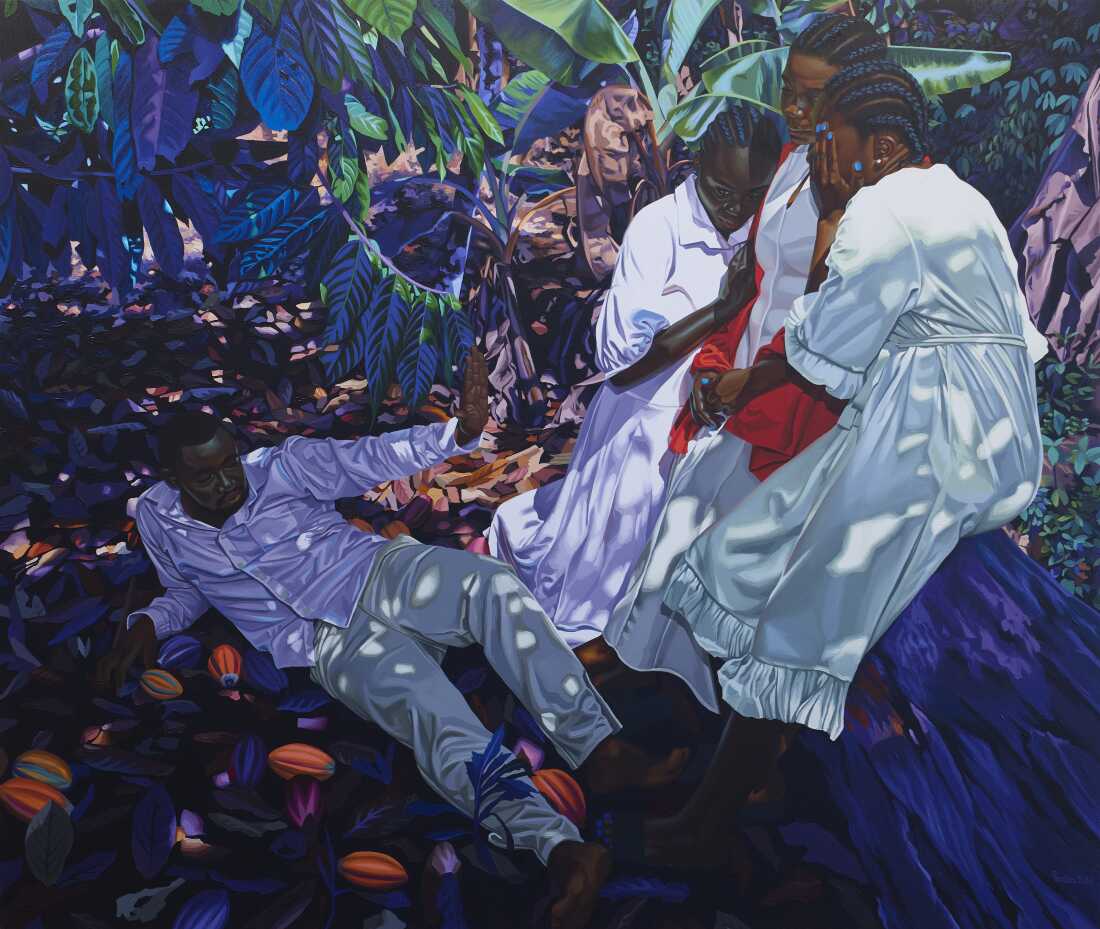
Marc Padeu, a Cameroonian artist, draws on the richness of Renaissance art, set in African contexts. His painting Sous le poids de la coupe, showcases this blend. Padeu states that as an African artist, he is an heir to a vast history but works in a region lacking artistic infrastructure. His art reimagines European religious scenes within Cameroon’s cocoa plantations.
The London gallery Larkin Durey showcases Padeu’s latest works. Gallery director Oliver Durey describes Padeu’s style as timeless, merging contemporary and traditional influences. Born in Bafang, Cameroon, Padeu now resides in Yaoundé.
Padeu explains his approach of integrating familiar Western images into his Cameroonian setting. He queries why images like the Nativity or the Last Supper must always conform to European depictions. These are universal themes of love and hope, relevant across different cultures.
Padeu’s path into art was influenced by his mother, a fashion designer. His interest blossomed in school, where he contributed to art demonstrations. He joined Cameroon’s first arts school, laying his foundations in traditional art history.
He cites African American painter Kerry James Marshall as a key influence. Through Marshall’s work, Padeu understood the integration of Black bodies into traditional art narratives, though he diverges towards themes of existence and spirituality in his own art.
Padeu initially painted church frescoes in Nkongsamba, witnessing firsthand the influence of religious imagery. He began developing a keen interest in religious paintings, particularly Renaissance works.
The Blue Virgin, inspired by Velázquez’s The Coronation of the Virgin, features a young African woman embodying serenity and universal themes like motherhood. The use of blue symbolizes both the Virgin Mary and a distancing from reality, focusing on symbolism.
Padeu’s upbringing straddled two spiritual traditions: his mother’s Catholicism and his father’s Bamiléké animism. This duality influences his work, melding traditional African settings with universal themes. He portrays Cameroonian life—particularly those working the land—with dignity and nobility.
His process involves long periods of conceptualization, using photographs of non-professional models from his community. Through these images, he constructs his scenes in the studio, reimagining lighting, expressions, and form.
Being an African artist in 2026, Padeu reflects on the lack of local infrastructure and the necessity of international recognition. This paradox requires African artists to engage with a global art ecosystem while drawing on their rich heritage.
Padeu advises aspiring artists to expand their horizons beyond geographical identity, embrace the history and philosophy of art, and not succumb to the pressure of immediate production. Art, for him, is a lifelong journey.
Padeu contends that he does not imitate great masters but dialogues with shared artistic heritage, placing ordinary people in noble settings, similar to historical religious imagery.
Despite a world rife with prejudice, Padeu focuses on crafting works that transcend categorization, advocating resilience against discrimination in the art world.
Ultimately, Padeu desires for his art to reach global audiences in challenging times, upholding George Bernard Shaw’s view on art’s essential role in making the world bearable.
Marc Padeu: Memento Vivere is on display at London’s Larkin Durey gallery until August 14.