
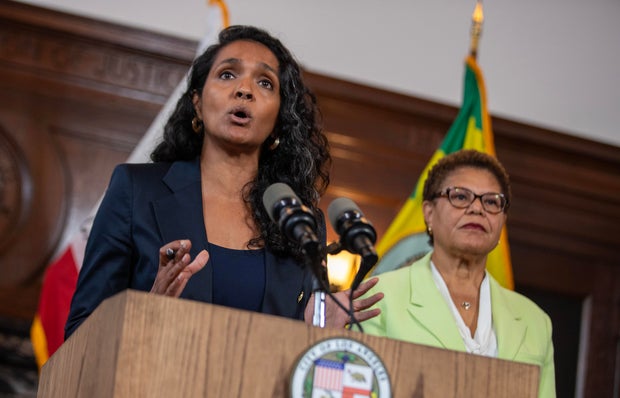
The Los Angeles mayoral race intensified as City Council member Nithya Raman secured a spot against incumbent Karen Bass in the November election. This development follows Raman’s significant voter gain, surpassing political newcomer Spencer Pratt. The primary election system in California allows only the top two candidates to proceed to the general election, regardless of party affiliation. Current results show Bass with 34.3% and Raman with 28.5% of the votes, with 93% counted.
Election Dynamics and Reactions
Pratt initially led over Raman by six percentage points but watched his lead diminish over recent updates. Raman overtook Pratt with less than a one-percentage-point margin, eventually increasing her advantage with over 33,000 additional votes, overtaking Pratt’s 25.8%. All candidates actively engaged their supporters, with Pratt remaining positive despite being surpassed. Bass’s campaign issued a critical statement about Raman shortly after she advanced.
“We look forward to winning against an opponent who allows encampments near schools and opposes increasing police presence,” the statement said, highlighting Hollywood job concerns and ICE raids.
Raman’s campaign expressed gratitude, feeling encouraged by the latest vote counts. She commended support received across Los Angeles and emphasized a continued push for a healthier, affordable city.
Candidates’ Strategies and Positions
A UC Berkeley-LA Times poll on May 28 showed a tight race, with Bass at 26%, Raman at 25%, and Pratt at 22%, noting a margin of error of 3%. Earlier polls indicated 40% of voters remained undecided, which later reduced to 10% as choices solidified.
The race received national attention following significant Los Angeles events in 2025, including the Palisades and Eaton Fires, immigration raids, and protests. These circumstances add urgency to the electoral atmosphere.
Mayoral Campaigns and Future Directions
Raman expressed gratitude upon advancing to the runoff, emphasizing continued efforts to challenge the status quo that favors powerful interests over working people.
“For too long, City Hall has prioritized political benefits for influential funders while ordinary people suffer with higher rents and reduced services,” she said, calling for unity in pursuit of a more equitable city.
Bass’s response highlighted readiness to confront Raman on key issues, emphasizing previous achievements and the foundation laid during her initial term.
Raman, originally a Bass ally, surprised many by entering the mayoral race. Previously endorsing Bass, Raman cited inaction on key city issues as her motivation for running. Her approach to homelessness has been scrutinized, especially her opposition to an anti-encampment ordinance in Venice.
Bass celebrated overcoming significant leadership tests, including the homelessness crisis, Hollywood labor strikes, and economic challenges, strengthening her position.
The Spencer Pratt Factor
Reality TV star Spencer Pratt emerged as a polarizing figure, initially leveraging his experience from the Palisades Fire to challenge existing political responses. His campaign noted the inadequacy of current programs addressing homelessness, advocating for mandatory treatment over additional housing solutions.
Despite not advancing, Pratt’s influence remains, fueled by significant online support and highlighted by Trump’s remarked interest. His engagement in upcoming debates emphasizes his commitment to challenging Bass’s policies.
Bass and Pratt both face anticipated scrutiny in upcoming engagements, keeping the spotlight on Los Angeles’s pressing issues as the electoral contest continues.