
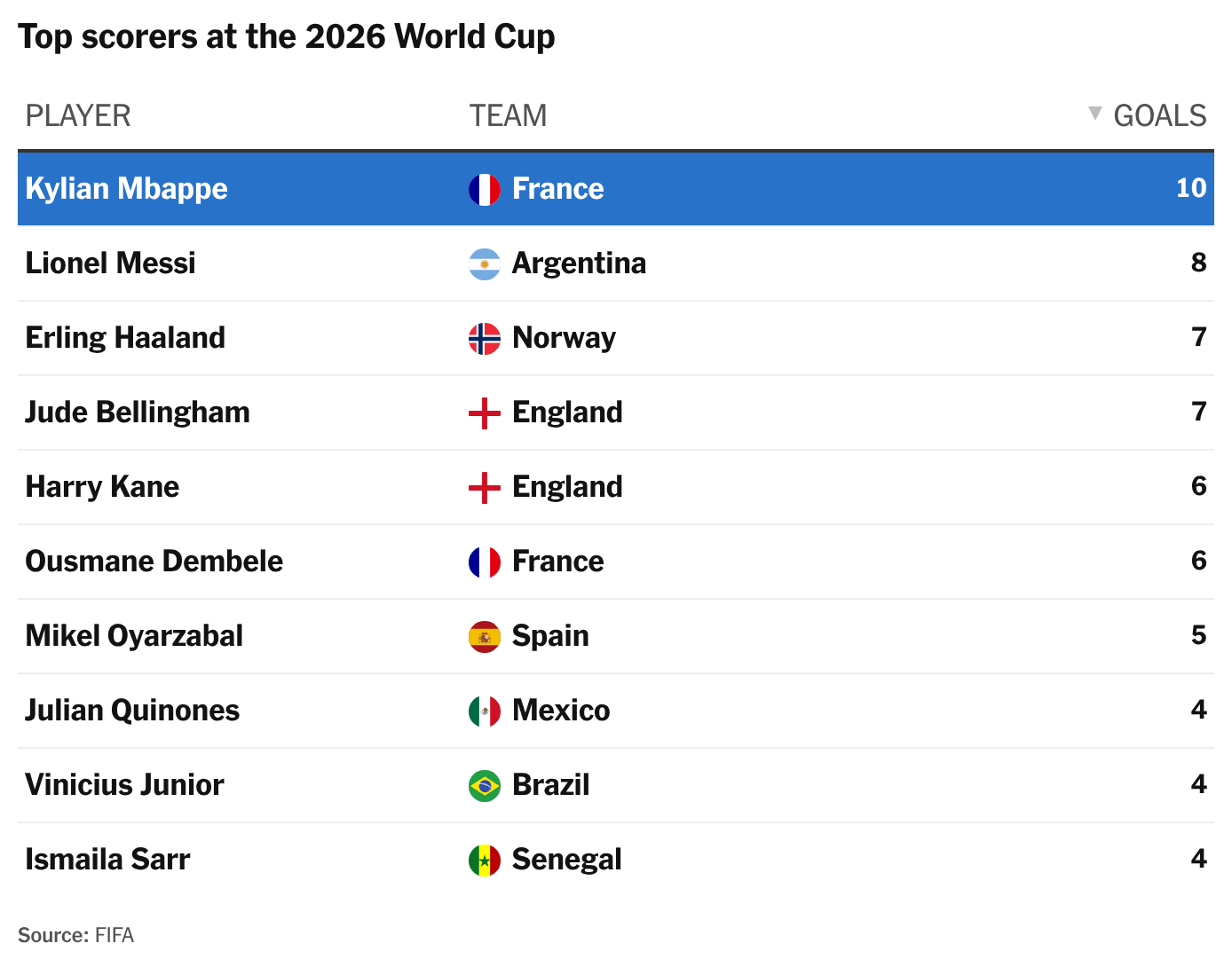
Spain achieved a 1-0 victory over Argentina in the 2026 World Cup final, which led to France’s Kylian Mbappe securing the Golden Boot. This marks his second triumph in this award, after having won it in the 2022 edition held in Qatar. Mbappe has now accumulated 22 World Cup goals, surpassing Lionel Messi by one goal in the all-time rankings.
The race for the Golden Boot was intense, with five contenders: Mbappe, Messi, Erling Haaland from Norway, Jude Bellingham from England, and Harry Kane. Mbappe claimed the lead during his final match, scoring two goals in a 6-4 defeat against England in the third-place play-off, overtaking Messi for the first time.
Mbappe’s achievement of scoring ten goals in one tournament is noteworthy, a feat not seen since Gerd Muller in 1970. Despite this, Just Fontaine maintains the record for most goals in a single World Cup, with 13 goals scored in the 1958 edition.
How Did Mbappe Score?
Mbappe’s success was rooted in precise finishing and swift movements into scoring positions. Though he scored twice from outside the penalty box, his ability to penetrate the area from the left was key. Guided by Didier Deschamps’ strategies, Mbappe thrived with Real Madrid teammate Michael Olise, who assisted him five times during the tournament. Their interplay was evident in Mbappe’s second goal against Sweden, coming from a smart reverse pass and ending in a confident shot to the far corner.
While Messi started strong with five goals in his first two matches, his scoring slowed, though he continued to influence Argentina’s performance. He provided two assists in the semi-final against England, helping his team reach the final. However, Messi struggled to assert himself in the final against Spain, with Argentina failing to register any shots until the 118th minute. This marked a subdued conclusion to his iconic World Cup journey.
Mbappe’s Breakaway Performance
Mbappe’s standout third-place play-off performance included scoring two goals against England. The first was a precise finish to the far corner after receiving a pass from Olise, and the second came from a well-executed one-two play. Historically, Golden Boot winners have leveraged this match for additional goals, including notable cases like Eusebio (1966) and Thomas Muller (2010).
Big scoring events are typical in these play-off matches, following Poland’s narrow 1-0 win against Brazil in 1974, and Fontaine’s record-setting four goals in France’s 6-3 victory over West Germany in 1958.
Post-World Cup League Performances
Golden Boot winners often score more in the domestic season leading to a World Cup than afterward. This pattern matches the experiences of players like Kane (2018), Muller (2010), and Lineker (1986), who maintain form into the World Cup but face physical effects from a taxing summer.
Exceptions include James Rodriguez (2014) and Ronaldo (2002), both excelling in league play with Real Madrid following their World Cup successes. Rodriguez made a transfer from Monaco to Madrid, while Lineker moved from England’s Everton to Barcelona, reflecting how Golden Boot acclaim can enhance player profiles. Lineker noted the global impact of his award, that shortly led to him joining Barcelona.
Mbappe’s Golden Boot win further cements his position as one of the all-time great scorers in football history.