
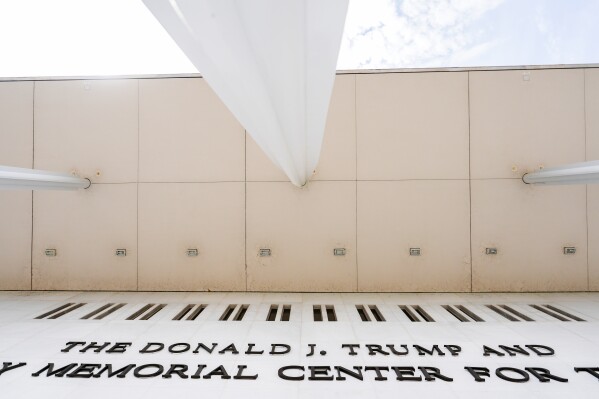
A federal judge has ruled that the addition of former President Donald Trump’s name to the Kennedy Center was illegal, blocking efforts by Trump’s administration to close the venue for major renovations. The decision marks a significant legal setback for Trump’s attempts to influence iconic sites in Washington, D.C.
In response, Trump announced that he would be stepping back from his proposed renovations, returning control of the cultural institution to Congress. Trump expressed his frustration on his Truth Social platform, stating that unless he had the freedom to restore the institution physically, financially, and artistically, he had no interest in pursuing what he described as a ‘hopeless journey.’
U.S. District Judge Christopher Cooper determined that the Kennedy Center board’s vote to close the facility was poorly considered and did not meet legal requirements. Plans for renovations, which were to commence in July and last two years, have been halted by this ruling. Cooper noted that the board could have evaluated the decision in various sensible ways but failed to do so.
The judge also found that the board overstepped its limits by adding Trump’s name to the center unilaterally. He emphasized that only Congress can rename the Kennedy Center, given its legislative origin. Cooper ordered the removal of Trump’s name from the building and all related materials within two weeks.
Following the court’s decision, Trump criticized Judge Cooper on social media and instructed his administration to arrange for the institution’s transfer to Congress. The Republican president has prioritized leaving a personal mark on Washington, D.C. during his second term. This agenda included previous actions like converting parts of the White House and featuring his name on various government buildings.
Opposition groups have successfully challenged several of Trump’s construction initiatives in court. While the administration plans to appeal these decisions, they face significant judicial obstacles.
Roma Daravi, Vice President of Public Relations at the Kennedy Center, expressed confidence that an appeal would support the Board’s wish to honor Trump’s contributions. Despite this, she acknowledged the pressing need for significant restoration of the facility, a sentiment echoed by the plaintiffs as well. The center has $257 million approved for renovations, underscoring the importance of preserving its status as a cultural landmark for all Americans.
In April, Judge Cooper held hearings for related lawsuits opposing the renovation project. One lawsuit, led by Rep. Joyce Beatty and supported by cultural and historic organizations, was successful in challenging the renovations without proper oversight.
Beatty welcomed the court’s decision as a victory for the Kennedy Center and the performing arts, hoping it enables a return to normalcy for the institution’s operations.
Meanwhile, Justice Department lawyers argued the planned renovations were modest and within the board’s authority. However, plaintiffs expressed concern over Trump’s plan to ‘fully expose’ the facility’s structure, fearing unauthorized changes similar to those seen in the White House.
The Kennedy Center’s Executive Director, Mike Floca, detailed the necessity of restoration during tours with lawmakers and officials. The ongoing performances have been limited, and facilities suffer from visible damage and aging equipment in need of replacement.
Trump’s recent involvement included attending performances like ‘Chicago,’ and further events are scheduled before any closure. The Mark Twain Prize for American Humor is set to be awarded to Bill Maher, marking a significant event prior to potential renovations.
This report included contributions from journalists Alanna Durkin Richer, Collin Binkley, and Darlene Superville.