
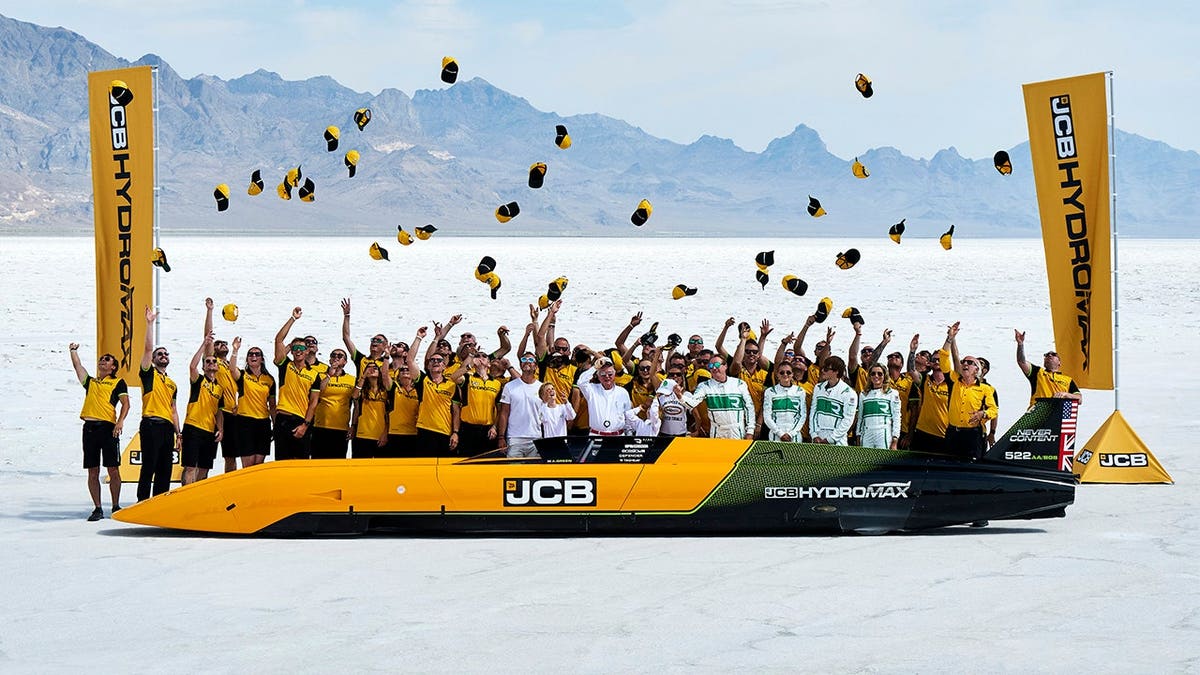
On a remarkable achievement at the Bonneville Salt Flats, JCB Hydromax showcased the speed of its hydrogen-powered car. The 32-foot vehicle, boasting twin engines, made two runs: clocking in an average speed of 400.623 mph on the first and achieving 412.135 mph on the second. The resulting average of 406.320 mph established a new world land speed record for hydrogen-powered internal combustion cars. This accomplishment far surpassed the previous benchmark set by the BMW H2R at 185.5 mph in 2004. The record awaits official confirmation by the Fédération Internationale de l’Automobile (FIA).
The engineering team has delivered an extraordinary feat, creating a new class for hydrogen racing at Bonneville Speed Week
, said Wing Commander Andy Green, OBE, who was behind the wheel for this groundbreaking event.
The process, often spanning three to five years to achieve a 400 mph speed, was accelerated by JCB Hydromax, achieving it within a year. Starting with a design meeting just over a year ago, JCB had nine months to design, manufacture components, and build the car. The car was assembled in five weeks, tested in the UK for three weeks, and then made its debut at Bonneville with the goal of setting a new record using hydrogen engines.
Despite facing challenges like engineering at 6,000 to 7,000 feet above sea level in 100 to 105-degree heat, the team successfully overcame these obstacles. The vehicle included about 400 pounds of ice and water to help maintain engine temperatures, a crucial strategy as the engines could not operate with hot air due to safety concerns.
The car also underwent tests to ensure rapid heating of oil to about 180 degrees Fahrenheit to prevent water from damaging engine components. Safety measures for stopping the car included a uniquely designed parachute system, vital to decelerating a 5,500-pound vehicle traveling at such high speeds.
Upon completing a 400-mph run, the team conducted a thorough inspection, confident to attempt pushing their boundaries. The subsequent 412 mph run, subject to FIA confirmation, reinforced the new world record with an average speed of 406 mph, accomplished in under nine seconds per mile.
While navigating the track, Andy Green noted the unique visual effects at such speeds, with marker boards appearing closer and the track narrowing as the car accelerated. Despite these challenges, the car stopped safely as per plan.
Green, who entered the high-speed racing domain from his background as a jet fighter pilot in the Royal Air Force, compared his driving notoriety to the cinematic portrayal by Tom Cruise. With a collegiate focus on mathematics and an understanding of supersonic vehicles, Green was well-suited for projects of such technical complexity.
Reflecting on his 1997 record of 763.035 mph, Green welcomed the potential ushered in by today’s hydrogen technology, hailing it as the dawn of zero-carbon motorsport. It’s an exciting future for motorsport, where hydrogen, made from sunlight and water, powers race cars to new speeds
, Green asserted.