
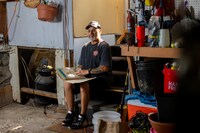
While organizing his garage, Jason Hurdle uncovered a crawl space revealing a dusty box filled with files. Initially regarded as garbage, a cover with the word “SECRET” caught his eye.
Hurdle, a mechanic from Waterloo, New York, wasn’t accustomed to handling classified documents. The contents turned out to be 80-year-old, handwritten accounts by American POWs during World War II. These pages detail harrowing experiences in German captivity, shedding light on cramped and unsanitary conditions.
“The nearly 300 pages included experiences of over 120 soldiers,” Hurdle disclosed, nearly discarding them.
In July, these records were recovered by the National Archives’ Archival Recovery Program, which specializes in locating lost or stolen federal documents. Other recoveries include Apollo mission records and a presidential pardon.
News of this discovery hasn’t spread extensively. Families of the POWs contacted by The Washington Post expressed surprise at the existence of such records. While some veterans shared their stories verbally, others remained silent about their ordeals.
The records stand out due to the scale of firsthand accounts, according to Kimberly Guise, associate vice president of curatorial affairs at the National World War II Museum. The discovery was unexpected for Hurdle, who found the documents in his wife’s family home.
Upon realizing the significance, Hurdle took the documents to a local museum dedicated to Memorial Day. With guidance from a docent and research historian, Amelia Burm, the documents reached the National Archives.
The discovery astonished the federal agency, which had no record of these documents being missing. Grace McCaffrey, spokeswoman for the National Archives, emphasized the importance of preserving these records for public access.
The first document examined by Hurdle featured a report from Colonel Darr H. Alkire detailing poor conditions in a German POW camp. These records reside in College Park, Maryland, marked “declassified.” Plans are underway for digitization and public access.
Though the origin of the records in Hurdle’s crawl space remains a mystery, he suspects they may have come from a former neighbor.
“This stuff is not found in history books. You can see and read it—very special to me,” expressed Hurdle.
American POWs reunited at Camp Lucky Strike in France, transitioning from harsh captivity to relative comfort. Exhaustive interviews collected intelligence and detailed their experiences.
One memo detailed POW conditions defying the 1929 Geneva Conventions. Evidence was gathered through interviews and forms—the soldiers answered questions about any atrocities they witnessed.
Accounts frequently began with capture in the Battle of the Bulge, leading to marches and train transfers to various camps. Experiences varied but generally included harsh, unsanitary conditions, limited food, and air raid exposure.
Several soldiers witnessed killings and beatings. Eugene William Eidschun recounted witnessing a shooting during camp evacuation.
Many narratives remained untold to families for decades. Michael Yanes said his great-grandfather Henry Daly was profoundly affected by his experiences, leading a disrupted life post-war.
Pete Dimas, whose father was a POW, seeks to document his father’s service, revealing post-war habits connected to prior scarcity.
The National Archives team responsible for recovering these files continues to work diligently, ensuring such discoveries are preserved and accessible.