
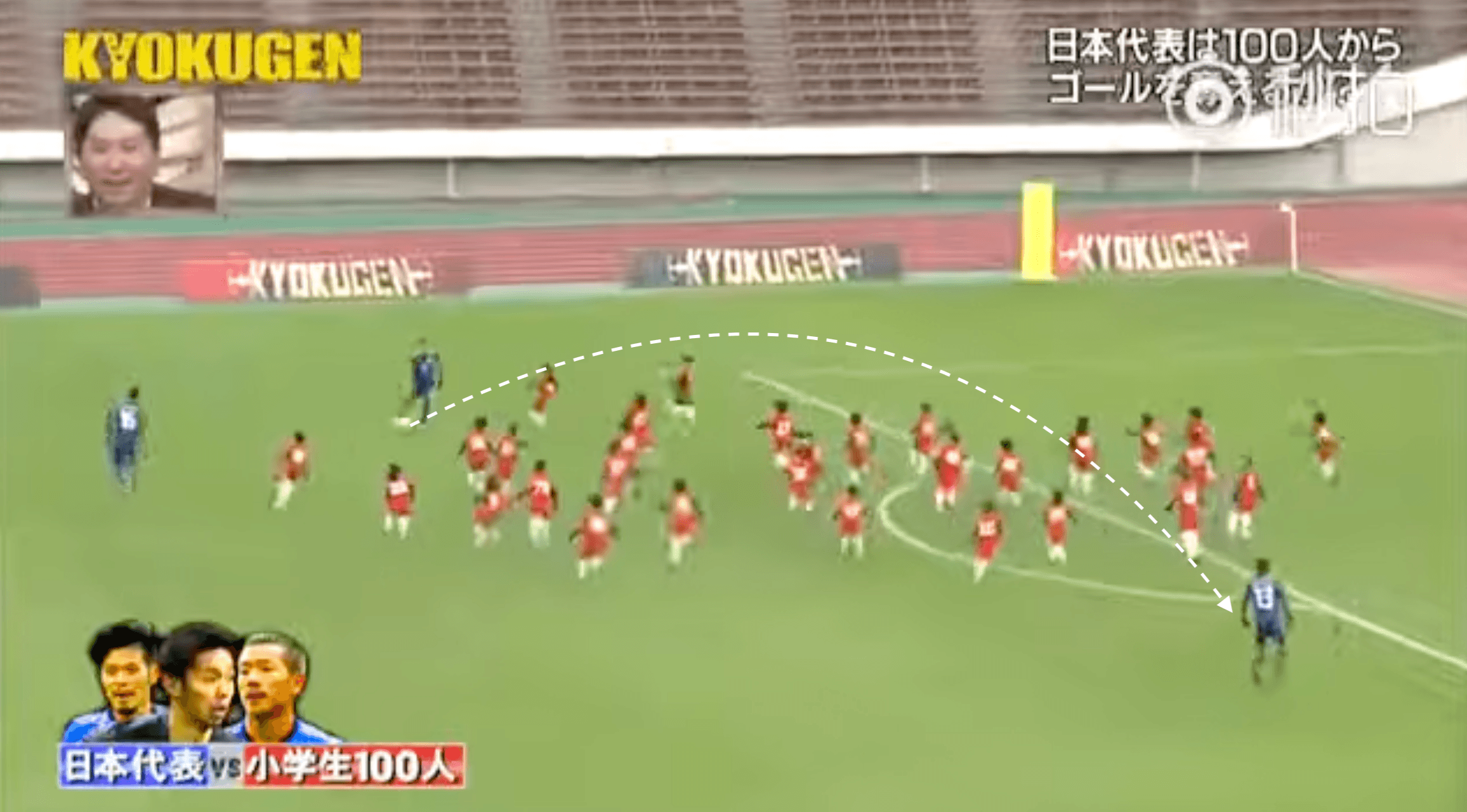
If you have spent any time on social media, you might have come across an intriguing clip from a few years ago. In this footage, three Japanese internationals—Hotaru Yamaguchi, Hiroshi Kiyotake, and Yosuke Ideguchi—take on 100 schoolchildren on a full-sized football pitch. The premise is humorous, but watching how the three manage to pass the ball amongst themselves while avoiding the children is fascinating.
Their key to success lies in exploiting the predictable behavior of the schoolchildren. As the kids always gravitate towards the ball on one side, the internationals switch play to the opposite side, where one player remains unmarked. This reveals the children’s lack of positional awareness.
The ability to identify and exploit space is a hallmark of their style.
This tactical approach isn’t just a novelty. It reflects the modern Japanese national team’s strategy when competing against traditional 10-player lineups. Utilizing a 3-4-3 formation, Japan creates a front five while in possession. This setup consistently troubles opponents as Japan aims to find unmarked players, allowing them to exploit the opposition’s blind spots.
Interestingly, Japan employs versatile wing-backs who are not limited to sideline runs. For example, right-sided Ritsu Doan is left-footed and left-sided Keito Nakamura is right-footed. This allows them to cut inside for shots or switch play with angled passes, adding unpredictability to their game.
One sequence during a 1-1 draw with Sweden illustrates this technique well. Central midfielder Daichi Kamada moved to the left, cut back to his right foot, and crossed towards wing-back Yukinari Sugawara, who couldn’t connect with the ball. Sweden partially cleared, leading Ao Tanaka to switch play back to Kamada, who volleyed a shot directly at the goalkeeper.
Late-game switches and finding a spare player at the far post define Japan’s play.
Japan’s next challenge is against Brazil, whose defensive weaknesses at full-back offer opportunities for exploitation. Right-back Danilo’s age and left-back Douglas Santos’ lackluster performance contrast with Brazil’s solid central defense, where Marquinhos and Gabriel are difficult to challenge in the air. Navigating past these areas without direct confrontation is Japan’s ideal strategy.
Other teams have resorted to reinforcing their lines against Japan. For instance, the Netherlands shifted Frenkie de Jong into defense, creating a back five to manage Japan’s wide play. It’s uncertain which Brazilian player might adapt similarly or how Brazil’s tactics will address this issue. Casemiro or Rayan may need to reconsider their roles, addressing Japan’s strategic threat.
This match carries significant weight, extending beyond the current tournament. While football globally is still dominated by Western European and South American teams, Japan symbolizes the emerging force. With strong infrastructure and admired tactical execution, Japan aims to make history by winning a knockout game in the World Cup for the first time, possibly by eliminating Brazil. A triumph over Brazil would be monumental, demonstrating the effectiveness of Japan’s tactical approach.