
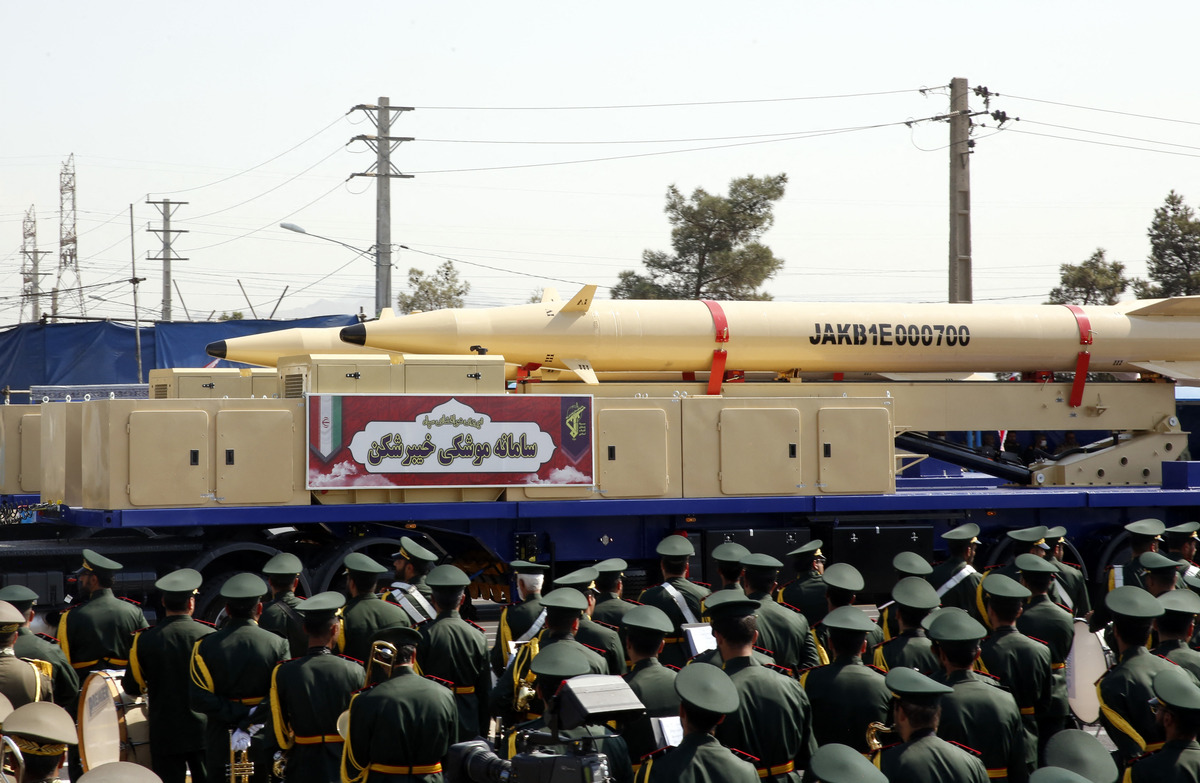
Iran’s New Military Strategy
Iran has adapted its military approach by deploying Kheibar Shekan ballistic missiles against U.S. military bases across the Middle East. These missiles modify flight paths, speeds, and mid-air maneuvers to penetrate American air defenses, according to unnamed U.S. officials in a report by The Wall Street Journal.
Rise in Regional Tensions
Since July, Iran has launched several missile attacks on American facilities in at least five Middle Eastern countries. These actions challenge a ceasefire established in June. This exchange has resulted in multiple nights of conflict, paused for brief periods.
President Donald Trump mentioned ongoing negotiations with Iran while keeping military options open. Both sides held back from initiating attacks for two consecutive days, signaling potential for diplomacy.
Iran’s latest actions included a strike on Jordan’s Muwaffaq Salti Air Base, resulting in the deaths of U.S. service members: 1st Lt. Tyler James Feehan, Private Isabella Gonzales, and Sgt. Angel Rampersad. Another casualty, Sgt. Michael Emmanuel Swinton, occurred at Iraq’s Erbil Air Base due to a drone incident, bringing the U.S. casualties to 18. Attacks also targeted U.S. facilities in Kuwait, Bahrain, and Qatar.
Kheibar Shekan Missile Specifications
First showcased in 2022, the Kheibar Shekan is an intermediate-range ballistic missile with an approximate range of 900 miles. This range covers the Middle East along with parts of Russia, India, and NATO member Turkey. The missile operates from mobile launchers using solid fuel, allowing for quick deployment and reducing the time opponents have to respond.
Named after the historical Battle of Khaybar in 628, the missile is part of Iran’s suite of solid-fueled weapons, which includes the Zolfaghar and Fattah-1 missiles. The Fattah-1 is claimed by Iranian media to reach hypersonic speeds exceeding five times the speed of sound.
Strategic and Economic Implications
According to U.S. officials, the integration of Kheibar Shekan missiles with jet-powered drones demonstrates an evolution in Iran’s tactical strategies. Though Tehran hasn’t disclosed the exact cost, these missiles are believed to be considerably less expensive than the interceptors used by the U.S. and allied forces, which range from several million to $15 million per unit. This economic factor might strain the sustainability of high-end defense systems.
Nicole Grajewski, a specialist in Iranian strategy at Sciences Po in Paris, noted that Kheibar Shekan missiles are cost-effective and flexible in terms of launch systems, proving impactful.
Meanwhile, Ukraine’s President Volodymyr Zelensky stated that Russian satellites have observed U.S. bases in the Gulf, sharing intelligence that correlates with Iranian strikes. This connection suggests strategic collaboration aimed at U.S. facilities.
Challenges for Air Defenses
While U.S. and allied forces have intercepted most missile attacks since the conflict began on February 28, some Kheibar Shekan missiles have bypassed defense systems, reported a U.S. official. Missile expert Fabian Hinz explained that Iran gathers data from each missile use, allowing them to refine tactics.
Ballistic missiles like the Kheibar Shekan are harder to intercept due to unpredictable trajectories, high speed, and ability to maneuver during reentry. Successfully countering such threats often involves overwhelming air defenses with sheer numbers. Retired lieutenant general Qasid Mahmoud noted that Iran uses simple missiles to distract radar systems before deploying advanced missiles that adjust targets near the end, complicating interception efforts.
For further details, contact Newsweek editors Daniel Orton and Anthony Murray.