
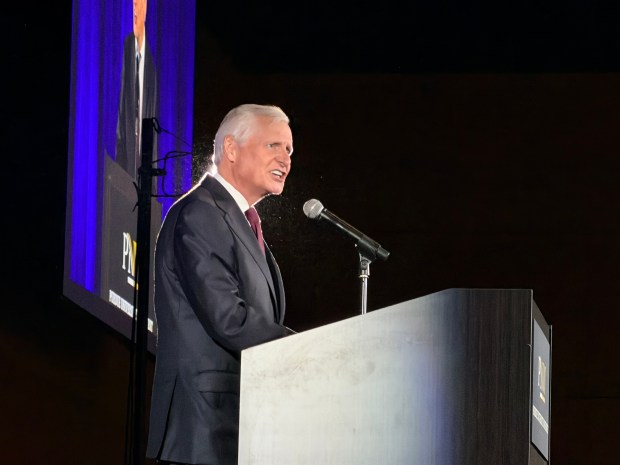
Jon Meacham, a presidential historian, highlights that democracy in the United States faces significant challenges. He believes that history shows Americans, with the right leadership, can overcome such crises. During a lecture at the Purdue Northwest Sinai Forum in Westville, Meacham emphasized the importance of viewing political rivals as opponents rather than enemies. He pointed out that a ‘crisis’ in public life resembles a critical moment in a disease where survival is uncertain.
Meacham drew parallels between the 2020s and the 1920s, presenting a historical context. He quoted Mark Twain, stating, ‘History does not repeat itself, but it does rhyme.’ In 1926, the U.S. had recently emerged from World War I, a time marked by empire shifts, severe battles, and advancements in warfare technology, including chemical weapons and aircraft. A pandemic, the Spanish flu, had also swept across the globe.
The Bolshevik revolution instigated global fears of armed socialist revolts, and totalitarian sentiments were rising. Anti-immigrant attitudes, protectionism, tariffs, and isolationism dominated the era. The Ku Klux Klan widened its targets to include immigrants, Jews, and Catholics.
The stock market crash in 1929 led to the Great Depression, with one in four American men unemployed and food riots occurring in the Midwest. Reflecting on resolutions to that era’s crises, Meacham credited Franklin Roosevelt as a pivotal figure. In Roosevelt’s 1933 inaugural address, he famously said, ‘The only thing we have to fear is fear itself.’ Yet Roosevelt also addressed the need for potential war-like executive powers to manage the crisis effectively.
Meacham recounted Eleanor Roosevelt’s concerns about the readiness for a dictatorial approach. That year, Smedley Butler revealed a plot where industrialists asked him to lead a coup against Roosevelt. These historical events serve as a reminder of the fragility and resilience of democracy.
Touching on the current decade, Meacham noted the country’s division, with tightly contested presidential elections. He observed that many Americans feel the nation does not have solutions that match today’s complex challenges. Meacham, residing in Tennessee, jokes about his conservative circle of friends, yet professes an identity as an ‘unabashed American constitutionalist.’
He stressed an obligation to speak truthfully and perceive fellow Americans not as enemies, but as rivals. Partisanship is inherent to American democracy, but extreme conflict is damaging. Using the example of the controversy over Obama’s tan suit, Meacham pointed out the profitability of conflict in media.
Discussing political differences, Meacham compared the Trump era to that of Richard Nixon. Although Nixon violated laws, he still respected legal conclusions, an approach different from current dynamics. Meacham acknowledged that initially, he believed the divisions from 2015 to 2020 were differences in degree, not kind. However, post-2020 election events altered his perspective.
Reflecting back on Andrew Jackson’s response to the 1824 election results, Meacham emphasizes the need for graciousness in both victory and defeat for national endurance. The age of Trump, as he describes, has reshaped the past decade, highlighting the impact of one individual’s influence and the subsequent political response.