
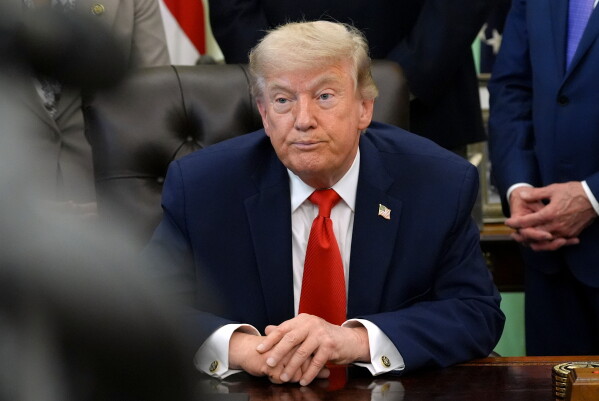
A new analysis from the AP-NORC Center for Public Affairs Research highlights a significant decline in support for President Donald Trump among independent voters during his second term. This trend is especially noticeable among independents without a college degree.
Initially, around half of these non-college-educated independents held a favorable view of Trump at the time of the 2024 election. However, this support has dwindled to about one-quarter by this spring. This change has eliminated the considerable education gap that existed among independents prior to Trump’s second term, with both college-educated and non-college-educated independents now holding similarly negative opinions of the president.
The analysis, based on nearly two dozen AP-NORC polls from July 2024 to April 2026, allows for a detailed examination of the evolving support for Trump over distinct periods, including the final months of 2024, Trump’s first 100 days, the summer of 2025 when significant legislation passed, last fall’s government shutdown, and the onset of the Iran war. The compiled data reveals a consistent decline in support among independents throughout Trump’s second term.
Trump’s standing has also weakened among specific groups that leaned toward him in the 2024 election, such as Black and Hispanic independents. These developments could pose challenges for Trump and the Republican Party in the upcoming midterm elections, often seen as a reflection of public sentiment toward the governing party.
Tafari Torres, a senior research associate at NORC and co-author of the analysis, emphasizes that while Democrats’ and Republicans’ views of Trump remained mostly unchanged during his second term, independents’ opinions have continued to fluctuate. “Independents are reacting to events and showing a decrease in support,” he stated.
Impact of Trump’s First 100 Days
Trump’s return to the White House was partly driven by independent voters who considered him strong on key issues like the economy. Yet, the analysis shows that once he assumed office, their views deteriorated swiftly.
Prior to and shortly after the 2024 election, independents without a college degree viewed Trump more positively than their college-educated counterparts. However, within his first 100 days, positive views among non-college-educated independents dropped from 48% to 31%. These views fell even further, reaching about one-quarter during the government shutdown and early months of 2026.
By contrast, only about 3 in 10 college-educated independents favored Trump before his return to office, so their decline was less significant. “The decline among no-college independents was steeper,” noted Sean Collins, a research associate at NORC and co-author of the analysis. “This was surprising given that those without college degrees typically form a core part of Trump’s coalition.”
Declining Support from Hispanic and Younger Independents
Those without a college degree have long been a crucial segment of Trump’s support base. Yet, in 2024, Trump also gained ground among traditionally Democratic-leaning groups, including Hispanic voters. According to AP VoteCast, about 42% of independent voters supported Trump in 2024, a rise from 37% in 2020. Independents without a college degree especially favored Trump over former Vice President Kamala Harris, with Hispanic independents almost evenly divided between the two candidates.
Currently, the situation appears less promising for Trump. Nearly 46% of Hispanic independents viewed him favorably around the election, but his approval plunged during his second term, sinking to 15% during the government shutdown and stabilizing around one-quarter this spring. Younger independents also became less supportive, while those aged 60 and older remained relatively constant. Other AP-NORC polls indicate Trump’s diminishing appeal among younger Republicans due to inflation concerns and growing dissatisfaction among Hispanic Americans.
Economic Concerns among Independents
Economic issues appear to be a major source of dissatisfaction with Trump among independents. About half of independents who backed Trump in 2024 cited inflation as their primary concern, as per AP VoteCast. Many were deeply worried about the cost of food and gas.
Despite more than a year into Trump’s second term, inflation remains high, driven by ongoing elevated gas prices linked to the Iran war. An AP-NORC poll in April found that approximately 3 in 10 independents felt extremely or very concerned about affording groceries and gas. Americans’ economic outlooks often align with their views of the president, and 8 in 10 independents described the U.S. economy as poor this spring.
The latest AP-NORC findings from May reveal that only about 3 in 10 independents approve of Trump’s economic management, echoing sentiments from the start of his second term. In April, merely 12% of independents approved of how he handled the cost of living.
This analysis covered 4,836 independents through 21 AP-NORC surveys, spread over five periods during Trump’s second term. Independents are defined as those who do not identify with or lean toward either major political party.