
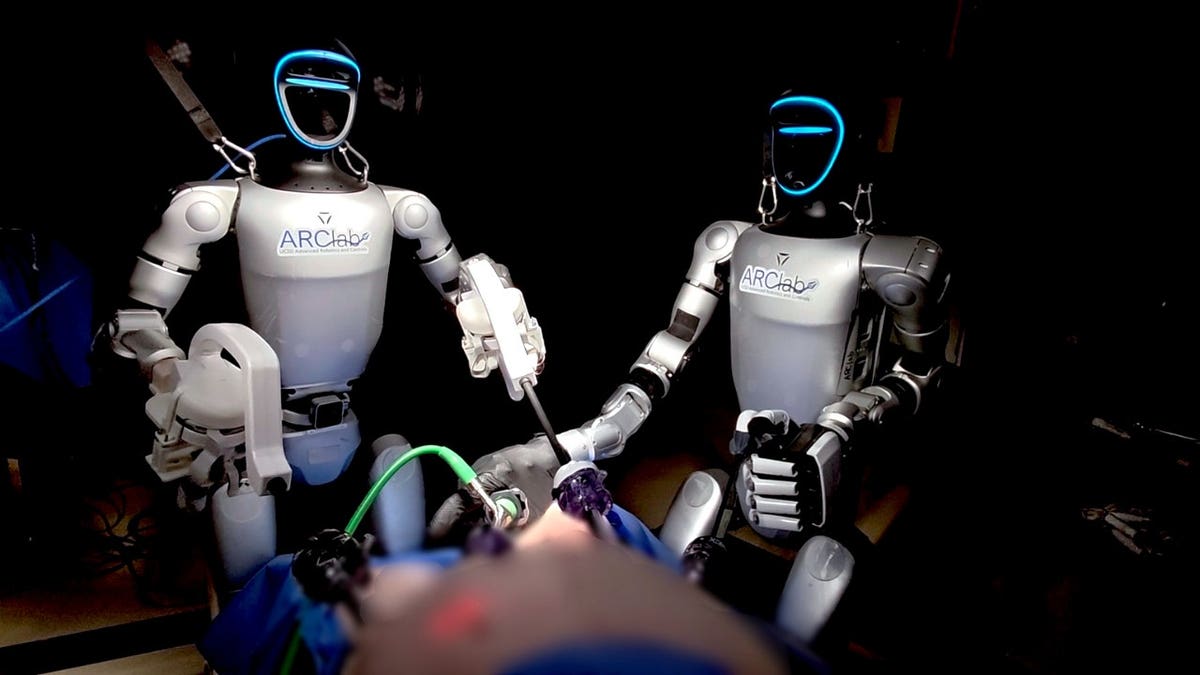
Recent advancements at UC San Diego have showcased a remarkable medical breakthrough. Doctors used humanoid robots, valued at approximately $20,000, to remotely perform gallbladder surgery on a pig. This innovation highlights the potential of artificial intelligence in addressing surgeon shortages and enhancing global access to medical care.
First-Ever Humanoid Robot Surgeries
Humanoid robots have made their debut in the medical field, helping complete two surgeries. During preclinical trials, surgeons guided these robots through gallbladder removal procedures. The robots mirrored the surgeons’ movements without making independent medical decisions, and the trial involved no human patients.
Unlike larger robotic systems that are fixed in place, these humanoid robots stand five feet tall and utilize standard surgical tools within a human-designed operating room. The research aims to allow specialists to perform surgeries remotely, especially in areas with limited access to surgical care.
Potential of Mobile Humanoid Robots
Researchers envision mobile humanoid robots offering surgical aid in rural clinics, field hospitals, and remote locations. Two humanoid robots recently completed surgeries, with results shared in the journal Nature. The team tested the robots by performing laparoscopic gallbladder removal on pigs, with surgeries executed under remote control.
During operations, tasks included moving tissue, dissecting around the gallbladder, and placing clips for removal. The trial served as a proof of concept, demonstrating a general-purpose humanoid robot’s capability to handle standard tools and complete surgery.
Despite its success, the trial exposed areas for improvement before considering human patient implementation. Teleoperated humanoid robots have now completed gallbladder surgeries, a first for general-purpose humanoid machines.
The Configuration and Costs of Humanoid Surgical Robots
The humanoid robots were adapted from commercially available Unitree G1 models, standing about 5 feet tall and weighing 60 pounds. They are significantly smaller than existing robotic systems like the Da Vinci surgical robots, which can weigh up to 1,800 pounds and cost between $700,000 and over $3 million.
Surgie, the modified robot, fits into standard operating environments and uses adapters for laparoscopic tools. It provided an advantageous workflow integration in existing medical spaces without requiring room renovations.
Advantages Over Traditional Robotic Systems
Current robotic systems usually remain stationary and utilize specialized equipment. Humanoid robots offer flexibility by operating in human-designed spaces and using hand-fitted tools. Future models could autonomously select instruments and assist in room preparation and cleanup.
Importantly, mobile humanoid systems could deliver specialized surgical skills to underserved areas, enhancing access to crucial procedures. The intention is not for robots to make medical decisions; rather, human surgeons will maintain control, executing remote surgeries to expand healthcare reach.
The Challenges Ahead
Despite the success of these operations, humanoid robots face limitations. Researchers re-calibrated them several times during surgery, and operations took longer compared to established systems. Additionally, latency, or operation delay between surgeon commands and robot actions, poses concerns.
Improving reliability and response time is necessary to ensure consistent performance across future procedures. Hospitals need backup plans and trained staff ready to intervene if robots malfunction or lose connection.
Autonomous surgical capabilities remain a long-term goal. However, new systems must recognize complications and respond safely, with human oversight ensuring accountability and safety during operations.
Implications and Future Prospects
The technology is in its early stages, with humanoid robots yet to act autonomously during surgeries. The experiment hints at potential robot-assisted medicine development. Future prospects include specialists providing expertise from afar, decreasing travel burdens for patients and offering hospitals expanded procedural capabilities.
Before undergoing robot-assisted operations, patients must understand control dynamics, contingency plans, and human team availability onsite. Human judgment remains critical in surgery, even as robotic assistance becomes more prevalent.
As research progresses, addressing healthcare access disparities through robotic innovation could transform medical practices and improve individualized patient care.