
The last communication Radhika Sharma received from her parents indicated they had crossed from Nepal into Tibet. Ramesh Sharma, 65, and Neelam Sharma, 64, both U.S. citizens residing in New York, were on a religious pilgrimage to Mount Kailash. This peak in Tibet holds spiritual significance for Hindus, Buddhists, and others.
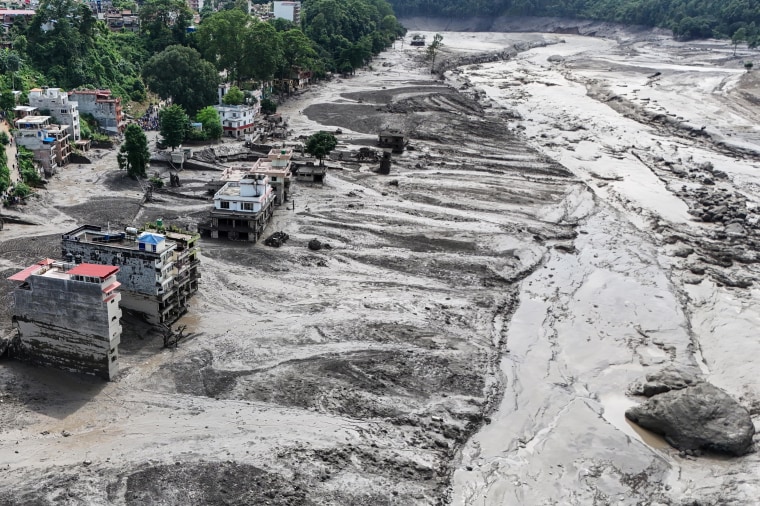
After their crossing, a destructive flow of water, rock, and mud surged through the Himalayan region. Videos from severely affected border areas captured scenes of chaos. People fled as debris consumed buildings, vehicles, and settlements, disconnecting roads, power, and communication networks. A suspected glacier collapse produced ground tremors akin to a magnitude-4.4 earthquake.
One clip from Mailung, in Nepal’s Rasuwa region, captured construction workers walking a mountain path. They noticed massive brown debris racing toward them. The men hurriedly changed direction to escape uphill. One briefly filmed the impending peril before grasping the gravity of the situation.
“Oh, my God, the flood is getting so big! Let’s run — run fast, guys! Oh, my God, get back quickly!”
By Thursday afternoon, 289 bodies were recovered in Nepal, with three confirmed deaths in Tibet. Numerous individuals remained missing. Nepal’s Tourism Board reported 644 travelers unaccounted for, including 65 Americans. Among the missing were Sharma’s parents, part of a group of seven on their pilgrimage.
“It has probably been the worst 24 hours of my life,” said Sharma, a North Carolina-based doctor. She anxiously awaited updates amid the disaster.
The hardest aspect was the uncertainty. Sharma reached out to U.S. embassies in Nepal and China and domestic American officials. “I haven’t heard anything back”, she shared.
After soliciting help via social media, she connected with contacts in Nepal. They are helping track her parents, sharing their information and photos. “I’m on the phone now, just waiting to hear someone say that they’ve even seen them.”
Sharma is among many seeking news of loved ones. The State Department confirmed coordination with local authorities to locate and aid U.S. citizens affected. They advised relatives to contact an emergency line.
The area’s remote, mountainous nature complicates travel and communication, exacerbated by the flood that destroyed infrastructure. Families struggle to obtain basic information.
In Baidur, Nepal, Shova Shrestha, 33, awaits word on her missing husband, Rajan Shrestha, during ongoing rescue operations.
“I keep looking at each helicopter, hoping he will step out of it,” Shrestha expressed to The Associated Press.
Sagar Pandey, CEO of a tour company, surveyed the devastation from a helicopter. He recounted, “There are no human-made things, no human settlement left. Everything is just flat.”
Syed Sadique, managing a tour agency in southern India, awaits news about 57 travelers with his company, including his son. The group was aboard three buses in Nepal. Sadique shared that one bus surmounted the flood safely, while another plunged into a gorge.
Amid chaos and frantic outreach to officials and locals, Sharma sent a heartfelt message to her missing parents. “I love you. I am looking for you. I will keep looking for you. I just hope you’re OK,” she conveyed.
Sharma added, “I know that wherever they are, they’re probably a lot more worried about my brother and I, because that’s just the type of people they are.”