
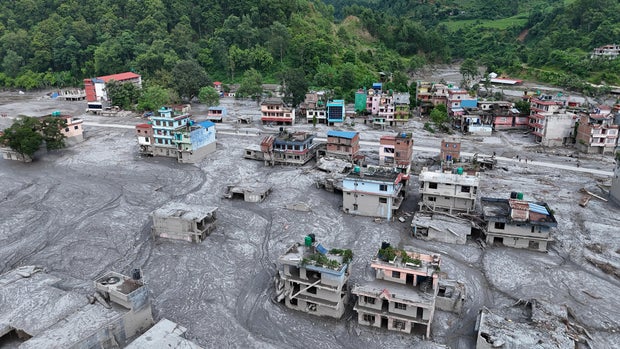
The recent flash floods in Nepal and along the border with China have resulted in severe casualties and widespread destruction. The death toll has climbed above 600, with approximately 3,000 individuals reported missing. Rescue operations have been continuous for four days.
Challenges in Rescue Operations
Adverse weather conditions are impeding aerial rescue efforts. Brig. Gen. Raja Ram Basnet from the Nepali Army noted that helicopter activities are paused until the weather improves. A significant number of individuals are believed to be trapped in a mud-filled tunnel at a hydropower construction site in Nepal’s Rasuwa district. Rescue teams have extracted some individuals, but the operation is slowed by extensive mud and limited landing zones.
Risk of Additional Flooding
Nepali and Chinese authorities have issued warnings of potential further flooding due to a new lake formation upstream. The lake is beginning to overflow, prompting relocation of rescue teams. Over 3,700 people have been rescued in Nepal, while China’s media reports 558 people are missing on its side. Among the missing are hundreds of foreigners, drawn to the area for work, trekking, or religious pilgrimage.
Scientific Explanation of Flood Cause
Research indicates that the floods were triggered by bedrock collapse beneath a high-elevation glacier in the Himalayas. The collapse registered as a seismic event, with the subsequent rock and water flow causing massive destruction downstream. Scientists continue to analyze satellite and ground data for more precise information.
Expert Jakob Steiner notes that glacial areas in the Himalayan region are increasingly susceptible to warming, driving rapid changes in glacial composition. Nearly 78% of glacier areas in this region are highly exposed to warming.
International Impact and Response
The U.S. State Department reported that five Americans have reached safety, but around 90 remain unaccounted for. The U.S. Embassy in Nepal has provided supplies and is coordinating additional assistance. Catholic Relief Services, partnering with Caritas Nepal, is delivering essential supplies such as food and shelter materials.
Among the missing Americans are participants from a pilgrimage conducted by the Isha Foundation, led by Indian spiritual leader Sadhguru Vasudev. The foundation has previously conducted such pilgrimages without loss of life.
President Trump remarked on the devastation, describing the destruction as severe. The U.S. has offered support to Nepalese authorities, displaying willingness to assist with resources.