
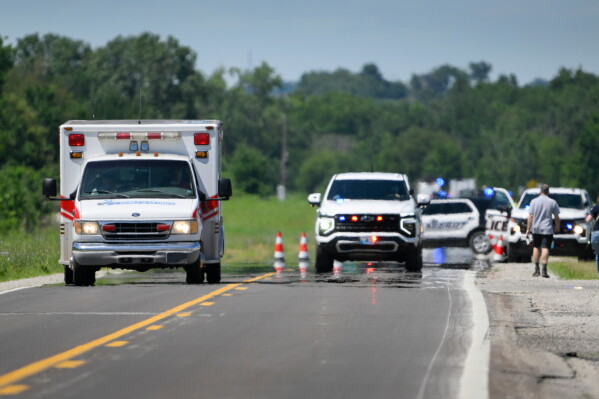
Federal investigators arrived at the scene where a plane carrying a pilot and 11 skydivers crashed shortly after taking off from a Missouri airfield. The tragedy claimed the lives of all on board. The crash occurred near Kansas City and resulted in a fire that destroyed the aircraft, according to authorities. Family members of the victims, some of whom were there to watch the skydiving activity, witnessed this devastating event, shared Bates County Sheriff Chad Anderson.
The identities of the deceased have not been publicly disclosed yet, but tributes from friends and colleagues have started to flow. Among the deceased is Jen Sharp, a technology director at the United States Parachute Association, which is the governing body for skydiving in the nation.
‘Jen was a remarkable force whose passion for the skies was matched only by her dedication to the people in our sport,’ noted Albert Berchtold, the organization’s executive director.
Sharp was influential in training skydiving instructors and contributed educational materials. Since her first jump in 1989, she completed 6,800 skydives. Her experiences included a notable jump into Denver’s Coors Field while dressed as the queen of England and participating in the Everest Skydive in the Himalayas.
Kevin Payne remarked on the community aspect of skydiving:
‘There is a joy and peace and freedom to what we do. It’s about really flying together with your family in that brief, exquisite instant.’
The National Transportation Safety Board (NTSB) will require about a month to provide a preliminary report on the crash. Meanwhile, weather conditions did not seem to play a role in the incident. The plane lacked a black box, common in commercial aircraft, but investigators are analyzing the wreckage for potential clues.
Witness reports suggest the plane was about 100 feet off the ground when an abrupt left turn led to the crash, believed to be an attempt to reach a highway. The acting airport manager, Dennis Jacobs, mentioned the pilot may have been trying to land when the aircraft stalled and nosedived.
The aircraft, operated by Skydive Kansas City, was a Pacific Aerospace 750XL, a model known in the skydiving community for its ability to reach required altitudes quickly. Built in 2010, the plane completed several successful flights prior to the crash, recorded by FlightAware.
Skydive Kansas City and the broader skydiving community were reeling from the incident, expressing deep sympathies to those affected.
The NTSB has previously questioned the sufficiency of inspections and oversight on skydiving operators. It noted that FAA inspectors failed to identify a critical issue in a previous Hawaii skydiving incident in 2019. Despite ongoing concerns about regulatory gaps, the FAA said it has formed a committee to explore ways to enhance skydiving safety, including some NTSB recommendations.
The United States Parachute Association affirmed that Skydive Kansas City complies with global skydiving standards and FAA maintenance requirements. While the skydiving industry cites a solid safety record, the association highlighted that of nearly 3.5 million jumps completed last year, 16 civilian deaths, primarily from human error, occurred.
Contributors to this report include Associated Press reporters Kristen M. Hall, Cathy Bussewitz, Rebecca Boone, and Hannah Fingerhut.