
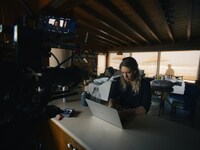
The documentary “You Can See Everything” has become a focal point of discussion among film enthusiasts. Directed by Nathan Fielder and Lance Oppenheim, it delves into the life of former Theranos CEO Elizabeth Holmes as she approaches her prison sentence for defrauding investors. The film’s release at the Telluride Film Festival generated significant buzz, with its opening weekend earning $15 million across 855 theaters. This mirrors the success of Michael Moore’s “Fahrenheit 9/11” in 2004, highlighting its impact on audiences.
Nathan Fielder is renowned for his unconventional storytelling. Notably, his series “The Rehearsal” and “Nathan for You” blend nonfiction with performance, creating unique narratives. In “You Can See Everything,” Fielder embeds himself in Holmes’s environment, exploring the blurred lines between truth and fiction.
The film captures real-time interactions between Holmes and Fielder, offering a perspective on her reality and past deceptions. The dynamic between Holmes and her partner, Billy Evans, adds complexity, presenting questions about manipulation and authenticity.
Discussions among Washington Post reporters highlight the film’s provocative nature. Fielder’s approach, coupled with Amanda Seyfried’s involvement in certain segments, raises questions about interpretation and perception, leaving audiences contemplating the film’s authenticity and their own understanding of truth.
The documentary fosters debate about the nature of truth, spotlighting Holmes not as the central figure but as a vessel for exploring broader themes through Fielder’s lens. For instance, moments like Fielder’s confrontations with Evans and Holmes spark laughter and reflection in audiences, revealing societal expectations of honesty and transparency.
Reactions to the film vary. Some, like Jade, express newfound sympathy for Holmes, while others, like Ethan, focus on Fielder’s immersive technique and its influence on the audience’s experience. Geoff’s mention of other works, such as “Adaptation” and “Being John Malkovich,” highlights how narratives can challenge perceptions of reality, drawing parallels to this documentary.
Ultimately, “You Can See Everything” leaves viewers pondering the essence of truth. It emphasizes the power of storytelling in shaping perceptions, encouraging contemplation of the inherent complexities when reality, fiction, and personal interpretation intersect.