
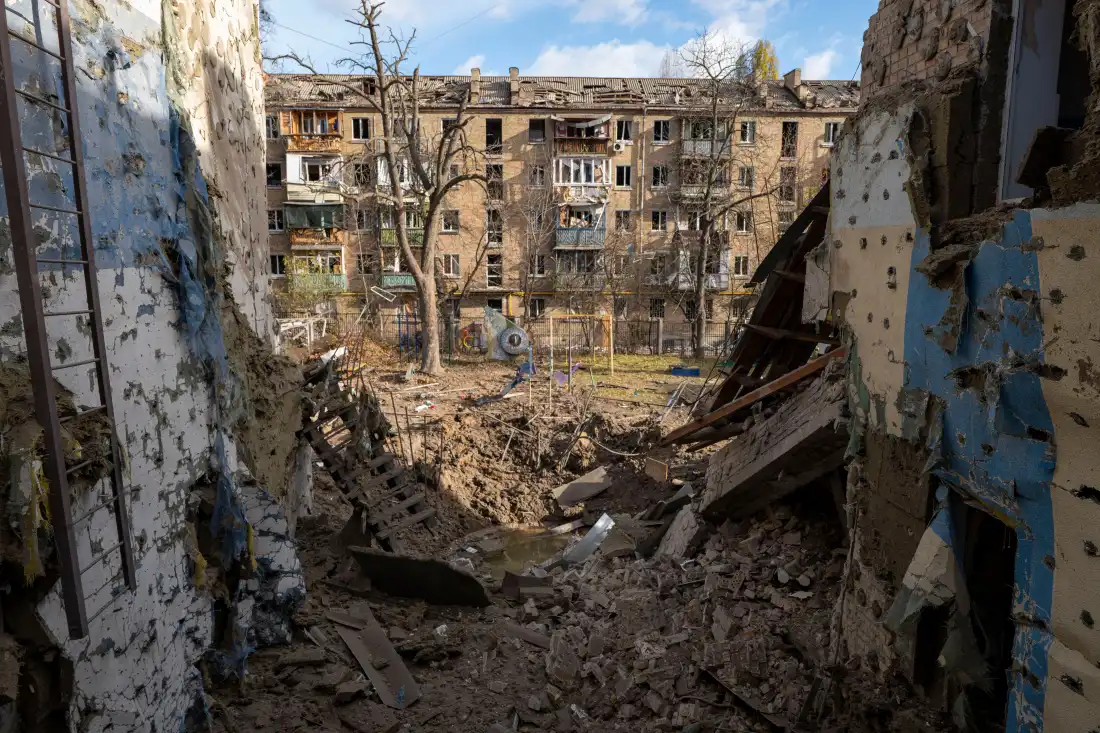
A view through the damaged walls of a kindergarten reveals a large bomb crater and a damaged residential building after a missile attack in Kyiv, Saturday, Nov. 7, 2026. Photo by Dan Bashakov/AP.
European officials are scheduled to participate in the U.S.-mediated peace talks between Russia and Ukraine in the United Arab Emirates this week, according to France’s foreign minister. On Sunday, Jean-Noël Barrot announced, “France will be present to ensure Europe’s voice is heard.” However, he did not disclose who would represent Paris or whether European officials would actively engage in negotiations or merely observe.
The meetings, set for Tuesday and Wednesday in Abu Dhabi, were initially structured as a trilateral session between Washington, Moscow, and Kyiv. Earlier, Kremlin spokesman Dmitry Peskov ruled out European involvement, citing an agreement on a trilateral format. Speaking on a Russian news channel, he criticized European countries for not designating a spokesperson while acknowledging that European involvement would eventually be necessary for security discussions.
Recently, former U.S. President Trump met with Kremlin envoy Kirill Dmitriev and noted that an impending agreement might “involve more than Ukraine,” and potentially all of Europe. Ukraine’s President Volodymyr Zelenskyy expressed concerns about the lack of details on the agreement and compared the situation to the 1945 Yalta Conference, where Europe’s division was settled without input from several affected countries.
Meanwhile, German Chancellor Friedrich Merz and Ukrainian President Zelenskyy held a press conference in Berlin, Germany, on Nov. 3, 2026. Photo by Ebrahim Noroozi/AP.
A Stalled Process Restarts
This will be the fourth set of talks mediated by the Trump administration and the first since the February negotiations in Geneva. Previous meetings achieved limited progress, especially as the Trump administration’s focus shifted to its conflict with Iran. Moscow agreed to return to the negotiating table following a visit by U.S. envoy Steve Witkoff with Russian President Vladimir Putin in October. Resulting talks led to Putin agreeing to release an American prisoner, reciprocating Trump’s earlier removal of sanctions on Russian diesel exports. Ukraine was strongly opposed to these sales, viewing them as a boost to Moscow’s war resources.
Witkoff stated that the agenda for these talks includes postwar security arrangements and conflict de-escalation, along with humanitarian issues. This follows an initiative by Melania Trump to broker a limited ceasefire, allowing humanitarian aid into a Russian-occupied Ukrainian town.
Russia’s delegation, led by Vladimir Medinsky, known for his hardline stance, will see the inclusion of Deputy Foreign Ministers Sergei Ryabkov and Mikhail Galuzin, along with Yury Zhigarlovsky and Igor Kostyukov. This senior lineup might suggest Moscow’s readiness to tackle political and military issues more seriously. However, the U.S. think tank Institute for the Study of War highlights that some Russian delegates have a history of delaying talks or reinforcing Moscow’s demands.
Significant gaps remain in the negotiations. Russia demands Ukraine’s cession of substantial territories and renouncement of NATO aspirations. Zelenskyy insists on clear security commitments, specifying actions in case of further Russian aggression.
Skepticism and Shifting Politics
Many analysts remain skeptical about the potential outcomes. Former U.S. Ambassador to Ukraine John Herbst argued in the Atlantic Council that Putin consistently rejects U.S. proposals favorable to Kyiv. Herbst suggested that “the only outcome of the talks may be the scheduling of another round.”
The discussions coincide with recent midterm victories by Democrats, which Zelenskyy believes could enhance Ukraine’s prospects for U.S. aid. Russia may seek to influence the Trump administration’s Ukraine deal outline before a Democrat-majority Congress takes over in January.
Simultaneously, discussions are reportedly in progress for a trilateral meeting involving Trump, Xi, and Putin at the Asia-Pacific Economic Cooperation summit in Shenzhen, China, later this month.
As officials gather in Abu Dhabi, the conflict continues unabated. Zelenskyy reported that Russia launched 36 missiles at the Kyiv area overnight, with only four intercepted, accusing Moscow of considering diplomacy as “a form of aggression.” Additionally, in southern Ukraine, the fatality count from a guided-bomb attack on an aid distribution site in Komyshuvakha reached at least 55.