
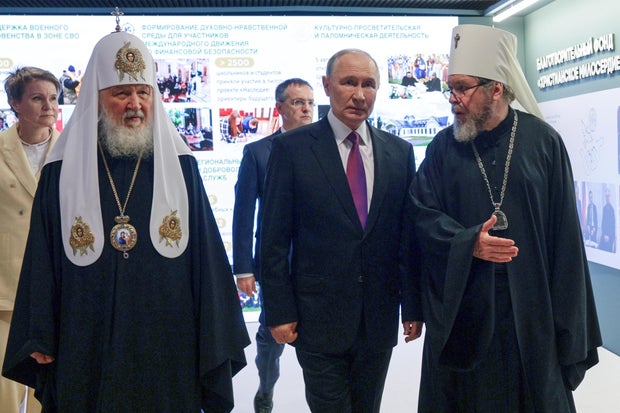
On Monday, the European Union took significant action in response to Moscow’s ongoing war in Ukraine. The bloc imposed sanctions targeting more than 80 individuals and entities. Among those sanctioned is an Orthodox priest tied to Russian President Vladimir Putin, referred to as his “confessor.”
The EU’s statement highlighted the inclusion of Georgiy Shevkunov, known as Metropolitan Tikhon. He holds a senior position in the Russian Orthodox Church and stands accused of disseminating Russian propaganda to justify the invasion of Ukraine. Although Russian media often cite Shevkunov as Putin’s “personal priest,” he has neither confirmed nor refuted these claims. In 2023, he was appointed Metropolitan of Crimea, a region Russia unlawfully annexed in 2014.
Last year, in February, Russia’s FSB security service reported arresting two individuals for allegedly attempting to assassinate the bishop, a plot said to have been ordered by Ukraine. Shevkunov is among 34 individuals and 47 entities added to the EU’s Russia sanctions list on Monday.
EU foreign policy chief Kaja Kallas emphasized the purpose of the new sanctions. “We approved another batch of sanctions to put more pressure on Russia to end the war,” Kallas stated. She highlighted that these measures target Russia’s military-industrial sector, a shadow fleet, and networks supporting Moscow’s hybrid attacks on Europe.

Kallas noted that previous Western sanctions had inflicted a financial toll exceeding $1 trillion on Russia. “Brick by brick, we are collapsing the foundations of Russia’s war economy,” Kallas remarked. The sanctions impact individuals and entities involved in producing and supplying drones and other military equipment to Russian forces.
The sanctions also target alleged propagandists, including a social media influencer named Alexandra Jost, as well as those aiding Russia financially via oil shipments. Further targets include 15 individuals linked to the poisoning of opposition figure Alexei Navalny. These measures entail asset freezes, travel bans, and restrictions on providing funds to those blacklisted.
“Every measure shrinks Russia’s room for maneuver,” Kallas added. The sanctions announcement coincided with Russia launching missiles at several major Ukrainian cities, which claimed at least 11 lives and ignited a fire at an important Orthodox monastery.
In response to this offensive, Ukrainian President Volodymyr Zelenskyy urged stronger actions from G7 leaders, assembled for a summit in France. The gathering was set to focus on the U.S.-Iranian agreement aimed at resolving the conflict. The Russian invasion, which began in February 2022, marks Europe’s most severe conflict since World War II, accounting for thousands of civilian deaths and significant troop casualties.