
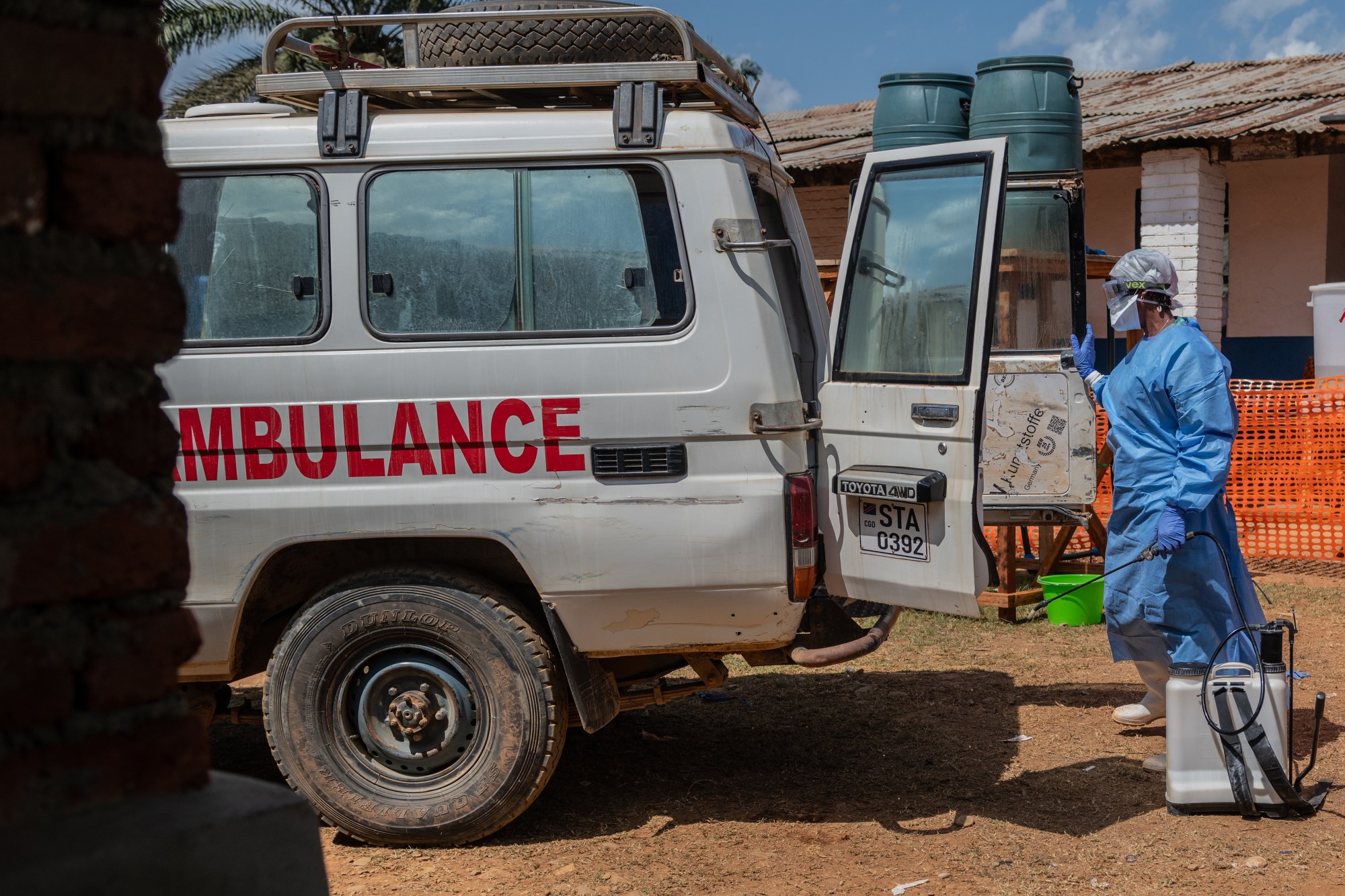
A health worker disinfects an ambulance at the Mongbwalu treatment center, responding to a possible Ebola case in Mongbwalu, Congo. The outbreak, linked to the Bundibugyo virus, has led to 617 confirmed cases and 117 deaths in the Democratic Republic of the Congo and Uganda.
The Trump administration has proposed using a U.S. military base in Kenya to quarantine and treat exposed Americans. This proposal is under scrutiny amid legal and ethical concerns from U.S. healthcare officials familiar with Ebola.
Ebola outbreaks are not new. More than 28,000 cases and 11,000 deaths occurred in Western Africa from 2014 to 2016, with a 39% fatality rate. Learning from past outbreaks is critical, yet current plans lack essential actions to contain the virus.
In 2014, federal screening at airports aimed to prevent U.S. spread. This early intervention coincided with just four U.S. cases and one death. The government supported medical centers equipped to manage Ebola, and at the time, America led a global humanitarian coalition supporting containment efforts.
Current challenges are compounded by the U.S.’s dismantled public health infrastructure over the past year and a half. A depleted CDC and the absence of the U.S. Agency for International Development further hinder responses.
Global infectious disease control depends on containing outbreaks at their source. Despite CDC efforts in the Congo, resource constraints weaken today’s response compared to a decade ago. The U.S. withdrawal from the World Health Organization further complicates these efforts.
The ongoing Ebola outbreak risks global spread. Air travel allows potentially infected individuals to travel from central Africa, posing risks to Europe, Asia, and beyond. Events like the upcoming FIFA World Cup in North America add to these worries.
U.S. residents exposed to Ebola aim to reach advanced treatment facilities in the U.S. quickly, increasing entry attempts. Ebola symptoms can take up to 21 days to appear, complicating the effectiveness of border controls. The current outbreak necessitates a focus on containment, yet symptoms and medications hamper detection at entry points.
The virus primarily spreads through direct contact with bodily fluids. Though risk is low, the potential for transmission beyond the Congo grows as the outbreak persists.
The State Department’s objective is American protection, but containment at the source remains vital. Screening methods and barriers offer limited protection, akin to building walls while ignoring a fire’s source.
Aviation security principles highlight focusing on threat sources for effective protection. Programs like TSA PreCheck and Known Crewmember rely on risk-based security measures. Similarly, addressing the Ebola outbreak requires resource allocation to the source of the risk for global safety.
Sheldon H. Jacobson, Ph.D., and Janet A. Jokela, MD, emphasize that risk management necessitates identifying sources and employing strategies to minimize impact. The priority in managing the Ebola outbreak should be aggressive containment strategies.