
The Justice Department is investigating whether five major television networks breached federal antitrust law by pausing pooled coverage of President Donald Trump. This pause followed CNN’s exclusion from the White House. ABC, CBS, CNN, NBC, and Fox News have been contacted by Justice Department officials. These officials requested communications and other materials related to the White House television pool, as reported by The New York Times.
The television pool is a long-standing arrangement where networks share the duty of covering the president. This includes distributing footage to various outlets. The issue arose when they stopped pooled coverage after the CNN ban. Later, coverage resumed following U.S. District Judge Timothy Kelly’s decision. He issued a temporary restraining order on September 24, mandating the White House to grant CNN access again.
On Saturday, the Justice Department publicly acknowledged the Sherman Act inquiry. A spokesperson stated, “Members of the television press pool have proudly boycotted covering White House events. Group boycotts among commercial competitors can violate the Sherman Act. The Antitrust Division is investigating to determine whether these news organizations have violated the antitrust laws.” Newsweek reached out to ABC, CBS, CNN, NBC, and Fox News for comment.
The Sherman Antitrust Act, established in 1890, is a fundamental law governing competition in the U.S. It prohibits agreements restraining trade and efforts to monopolize markets.
Cornell Law School’s Legal Information Institute explains that the law outlaws contracts, combinations, or conspiracies restricting interstate commerce. It also prohibits monopolization efforts. The act consists of two main sections tackling different forms of anticompetitive conduct. Section 1 targets trade-restraining agreements among competitors, while Section 2 addresses market monopolization. Violations may lead to civil enforcement actions or criminal prosecution by the Justice Department.
The Sherman Act has featured prominently in key antitrust cases, including the breakup of Standard Oil in 1911 and AT&T in 1984. More recently, it has been central to significant government cases against companies like Microsoft and Google.
DOJ’s Reason for Citing the Sherman Act
This investigation focuses on whether the networks’ coordinated suspension of pooled coverage represents a group boycott under antitrust law. The Justice Department is determining if competing media organizations acted collectively in halting pool footage following CNN’s exclusion.
The television pool comprises CNN, ABC, CBS, NBC, and Fox News. According to Reuters, these organizations share coverage costs, rotate responsibility for gathering footage, and distribute video to news outlets nationwide.
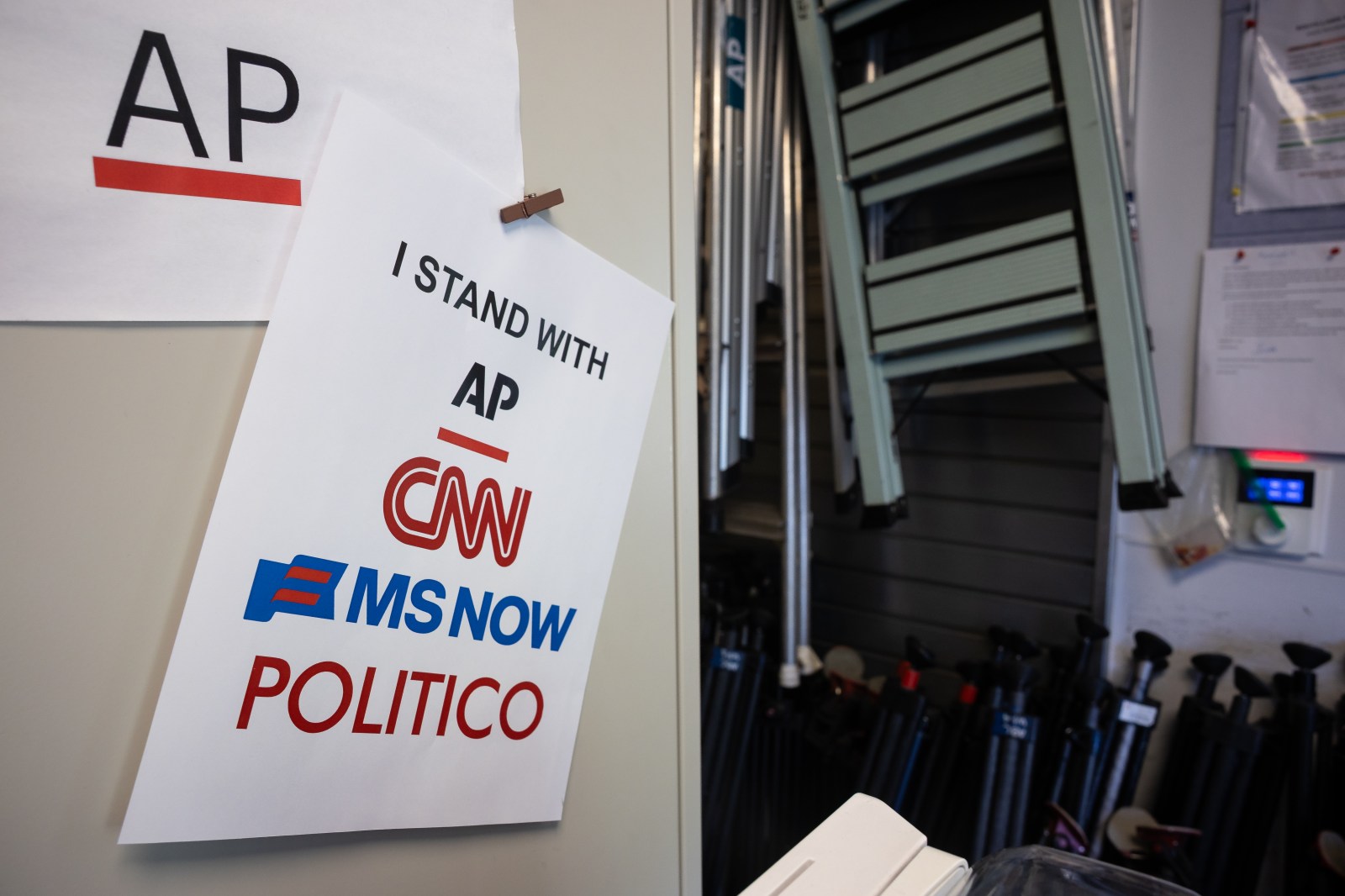
Disputes started when Trump barred CNN, Politico, and MS NOW from the White House on September 18, citing “purposely negative stories.” These organizations argued in court that the ban violated their First Amendment rights. A federal judge temporarily blocked these restrictions, though the order was set to expire on Tuesday.
This legal and political conflict escalated Monday after Politico was prevented from traveling aboard Air Force One. The move hindered Politico from fulfilling its role as the designated print representative in the presidential travel pool, intensifying the press access dispute.
A Politico spokesperson confirmed their exclusion, saying, “We do not have additional comment at this time, but would refer you back to our legal filings, previous statements and those from our attorney, Ted Boutrous.” The White House declined to comment about the Air Force One ban.
This investigation is the latest conflict between the Trump administration and major news organizations. Previous incidents included the Justice Department subpoenaing New York Times reporters and seizing a Washington Post journalist’s laptop.
The Associated Press has been engaged in a legal battle with the Trump administration since February 2025. Restrictions were imposed on its journalists after the outlet referred to the “Gulf of Mexico” instead of Trump’s preferred “Gulf of America.” The AP sued, alleging retaliation and a First Amendment violation. While a federal judge ordered restored access, an appeals court allowed the restrictions during the case.
Reuters and HuffPost have not faced broader restrictions. However, they experienced exclusion from Trump’s first Cabinet meeting in February 2025. Reuters had long participated in the press pool, whereas HuffPost was scheduled to provide the day’s print pool reporter before being replaced.
Whether the DOJ’s Sherman Act investigation will lead to enforcement action remains uncertain. Currently, the Justice Department is assessing whether the networks violated federal antitrust laws.