
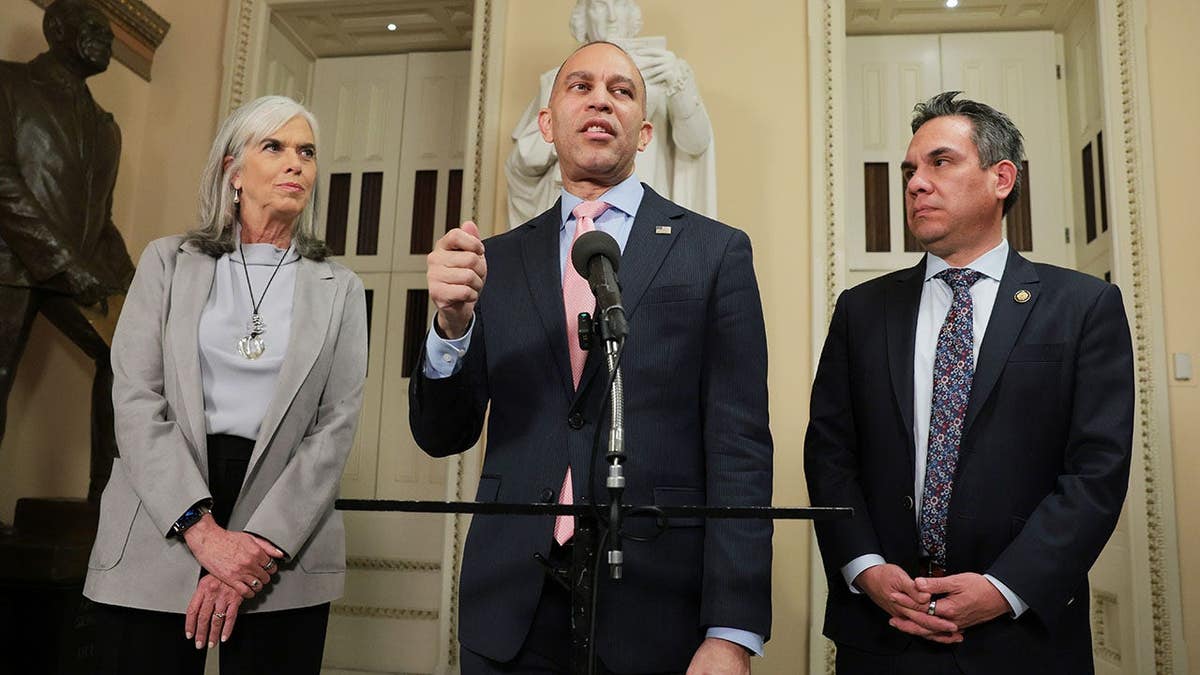
Democrats are showing clear division over legislation aimed at terminating aid to Israel. This highlights shifting attitudes within the party as support for the Palestinian cause increases. Recently, House lawmakers voted 104-313 to reject an amendment cutting $3.3 billion in foreign aid to Israel for the next fiscal year. The vote was notable for its split even within House Democratic leadership, which did not direct members on how to vote.
This was the first opportunity for lawmakers in this Congress to express their views on taxpayer-funded aid to Israel. House Minority Leader Hakeem Jeffries, D-N.Y., joined 97 other Democrats in opposing the amendment, while Rep. Katherine Clark, D-Mass., supported it along with 102 Democrats. Ten Democrats opted to vote present.
Rep. Thomas Massie, R-Ky., known for his critical stance on Israel, introduced the amendment as part of a State Department appropriations bill. He argued that Israel is the largest recipient of U.S. welfare. Massie was the only Republican to back the amendment.
“The same terrorists and terrorist entities that threaten Israel also threaten the United States and our people directly,” said Rep. Mario Diaz-Balart, R-Fla. “Giving Israel the tools to eliminate these threats makes America safer.” He added that most of the aid funds are used by Israel to purchase U.S.-made weaponry, which supports the U.S. industrial base.
Some prominent Democrats shared criticism of Massie’s amendment. Former House Majority Leader Steny Hoyer, D-Md., argued that the amendment would embolden Israel’s opponents, seeking the country’s destruction.
Despite the overwhelming defeat of the amendment, its supporters viewed the result as progress. Congressional Progressive Caucus Chair Greg Casar, D-Texas, celebrated the increased number of Democrats voting to stop aid.
Jeffries, who announced his opposition to the amendment during a private meeting, criticized its drafting. He believed the measure could limit funding for humanitarian aid and other initiatives. House Democratic Caucus Chairman Pete Aguilar, D-Calif., agreed with Jeffries’ assessment.
Clark and other Democrats disagreed, pointing to Israel’s actions in Gaza as a reason to reconsider financial support. Rep. Joaquin Castro, D-Texas, emphasized the need to use leverage against Israel, expressing that many Americans do not support further arms aid.
The proposed amendment did not prevent the cutting off of non-military aid to Israel, which some saw as dangerous to national security. Rep. Greg Landsman, D-Ohio, argued that Republicans used the measure to expose divisions within the Democratic Party.
Recent polls show a hardening stance against Israel among Democrats. An NBC News survey in March indicated that 67% of Democratic voters sympathize more with Gaza than Israel.
The Democratic landscape is changing, as illustrated by New York primary victories for socialist candidates opposing Israel. Meanwhile, Rep. Ro Khanna, D-Calif., has been questioned about his stance on Hamas’ actions, reflecting the growing hostility toward Israel within the party.
Amidst these changing attitudes, some Democrats anticipated Massie’s amendment gaining considerable support. Rep. Alexandria Ocasio-Cortez, D-N.Y., suggested that broad concerns may drive increased backing for such measures.