
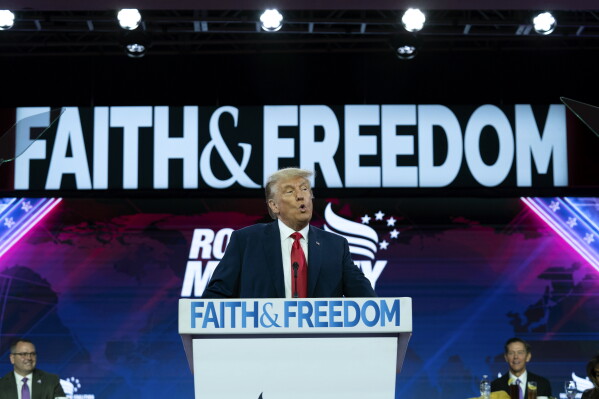
The U.S. Constitution does not mention Christianity or any particular religion. The Declaration of Independence refers to rights deriving from a ‘Creator’ and ‘Nature’s God,’ without specifying further. Yet, many Americans believe the founders intended the U.S. to be a Christian nation and believe it should be one. Such views are prevalent among Republicans and white evangelicals. These views are being echoed by supporters of Donald Trump as he campaigns for the presidency.
The Notion of a Christian America
The idea of a Christian America varies among individuals. Polls reveal many Americans hold God-and-country beliefs. Within this group, a smaller subset sees the U.S. Constitution as divinely inspired and supports the notion that the U.S. should declare itself a Christian nation and promote Christian values. This subgroup tends to have unfavorable views toward immigrants and may downplay the impact of anti-Black discrimination. They are more likely to view Trump as a commendable president, according to a 2021 Pew Research Center survey.
Christian Nationalism Explained
Christian nationalism blends American and Christian symbols and values, seeking to prioritize Christianity in public life. It provides a national origin story, conveying a sense that the U.S. is undertaking God’s work. Eric McDaniel, an associate professor at the University of Texas, describes it as creating a sense of ‘national innocence,’ which may discourage addressing troubled aspects of U.S. history.
Christian Nationalism in Politics
Donald Trump has echoed Christian nationalist ideas, such as restricting immigrants who ‘don’t like our religion.’ Many Republicans and conservatives advocate for Christian national origins but often reject the ‘Christian nationalist’ label. Republican House Speaker Mike Johnson stated that America was founded as a Christian nation and referred to Thomas Jefferson as ‘divinely inspired.’
WallBuilders, an organization influential to Johnson, claims historians have downplayed America’s Christian origins, despite criticism for historical inaccuracies. Their lawsuit challenges the rejection of bus ads claiming founders’ beliefs in Washington, D.C.
Dissenting Voices
Some figures, like Rev. Robert Jeffress, acknowledge America’s Christian roots but don’t support the idea of it being a Christian nation. He stresses the importance of Judeo-Christian values without denying rights to non-Christians. Anthea Butler, a religious studies professor, argues history negates the notion of a Christian nation.
John Fea, a history professor, suggests those proposing a Christian America base their claims on weak historical foundations, using history to further political goals. He points out that some key founders did not strictly adhere to Christian orthodoxy, showing the complexity of the nation’s foundation.
Survey Insights
A 2022 Pew Research Center survey indicates that six in ten U.S. adults think the founders intended for a Christian nation, with 45% supporting this notion today. Notably, 80% of white evangelicals agree with both assertions. In 2023, a third of adults believed God meant for America to be a European Christian promised land, according to a Public Religion Research Institute report.
The Constitution prohibits religious tests for office and ensures religious freedom, with the First Amendment preventing the establishment of any religion. Yet defenders of Christian nationhood can cite early state sponsorship of churches and rhetoric from founders like John Jay and Patrick Henry. However, other founders like Jefferson, Adams, and Franklin valued Jesus as a teacher but not as divine.
Fea cautions against oversimplifying historical interpretations. While some stress religious intentions, others claim that founders aimed to exclude religion from public life entirely. Both views lack nuance needed to understand the 18th-century context.