
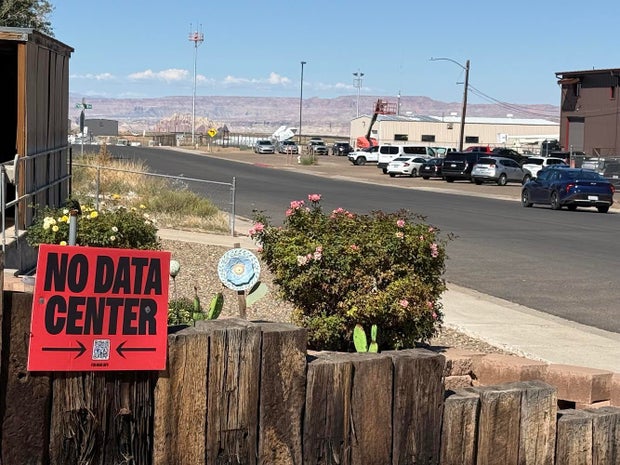
Doug Herrera remains in the house built by his late father, who passed away due to cancer. Herrera suspects the illness could have stemmed from pollutants linked to nearby uranium mining. Now, he fears that a proposed $10 billion mega data center next door may threaten his health. From his front porch, adorned with a sign stating ‘No Data Centers,’ Herrera expresses strong opposition: ‘I’m a patriot, but I’m highly against the data center.’
Page, Arizona, is renowned for its unique Southwestern landscapes, featuring arid deserts, Joshua trees, and majestic red-rock formations. While the City Council has sanctioned the land sale for the data center, further zoning and approvals are necessary for the developer. This development has sparked concern among residents, prompting petitions and mobilization efforts to halt construction.
The proliferation of data centers is causing rifts in communities like Page, becoming a key issue in the midterm elections. Leading candidates in Arizona’s 1st Congressional District are divided on the matter, while the state’s attorney general advocates for pausing new data center approvals and construction. A developer in Page has procured 500 acres to establish a data center. Robert Housman spearheads research scrutinizing data centers’ health effects, providing ammunition to Democrats and some Republicans diverging from party lines to oppose these complexes.
This divisive issue has placed incumbent politicians who previously supported data center expansion in vulnerable positions in traditionally Republican states like Ohio and Texas. Currently, numerous megabuildings operate there.
Lee Hannah, political science professor at Wright State University in Ohio, observes that the grassroots opposition against such projects has rapidly emerged. This uprising has endangered the careers of local officials who initially backed data center expansions.
Hyperscale centers, primarily housing AI infrastructure, require immense spaces for servers covering tens of thousands of square feet. The city of Page has approved the sale of 500 acres for one proposed data center, yet specific site within the acreage remains undetermined. The area encompasses open land populated by blackbrush and native grasses, near the famed Horseshoe Bend along the Colorado River.
Data centers require substantial energy and depend on backup gas generators during peak demand periods. Environmental studies have associated resulting air pollution with heart disease, respiratory issues, and heightened cancer risks. Research led by the University of California-Riverside predicts emissions from these centers may lead to nearly 1,300 annual deaths by 2030 and a public health burden exceeding $20 billion by 2028.
Data centers incorporate cooling components containing ‘forever chemicals,’ synthetic substances that accumulate in human tissue, as per advocacy and environmental groups. Generators and heating systems can generate noise levels beyond 90 decibels, detrimental to hearing.
Operations and security measures at data centers lead to light pollution, potentially elevating chronic disease risks. High-temperature zones known as data heat islands emerge due to hefty energy demands.
Alison Steele, executive director of the Environmental Health Project, cautions that ‘the very early edge of research into health impacts of data centers is emerging. By the time substantial research is available, decisions may have already been finalized.’
A trade organization representing the data center industry argues that a review of Virginia’s largest data center market shows minimal reliance on diesel generators for backup power. Existing state and federal regulations, they argue, mitigate emissions and potential impacts.
Political concerns over data centers are polarizing candidates, placing some GOP contenders at odds with President Trump, who advocates for facility construction as vital for economic growth. A Washington Post-ABC News-Ipsos poll from October reports two-thirds of Americans oppose new data centers in the U.S.
Such political conflicts predominantly arise in states Trump won in 2024, where most new data center projects are proposed. Over 1,400 data centers currently operate nationwide, with more than 2,000 planned for future construction.
A Cleanview report claims 60% of data center projects under construction are in states Trump won by five percentage points or more. Excluding Virginia, 92% fall under states won by the president.
Hannah warns that the rise in construction jeopardizes Trump’s support base due to rural data center placements. Trump often enjoys substantial support in rural areas.
Page hosts signs opposing data center construction throughout its neighborhoods. Within the state, GOP House candidate Jay Feely, backed by Trump, claims centers are essential in matching China’s progress. Meanwhile, Democratic opponent Amish Shah demands a pause on new construction in their district.
The competitive House race could prove crucial for determining party dominance following the November 3 midterm elections. In Arizona, an August Noble Predictive Insights poll reveals 57% of registered voters oppose additional large data centers.
Political advertising featuring politicians participating in previous data center groundbreaking ceremonies now serve as campaign fodder.
This presents challenges for elected officials in Ohio, where more than a dozen local referendums and initiatives relate to facility construction. The state features the highest number of such ballot measures nationwide.
Former Democrat Sen. Sherrod Brown seeks to return to Congress, critiquing incumbent Republican Sen. Jon Husted for endorsing data centers. Ohio has awarded roughly $2.5 billion in tax breaks over the past decade to tech giants like Meta, Amazon, and Google, driving growth in data centers across the state. This boom has incited protests fueled by residents concerned about health, environmental, and financial repercussions.
Brown directly targets Husted with campaign ads that label him ‘the face of data centers.’ Among other claims, Brown highlights data center expansions’ negative impacts on farmland, water, and energy usage.
An August memo from the National Republican Senatorial Committee cautioned that Brown’s stance on data centers poses a significant threat to Husted’s campaign.
An early-October Ohio Northern University and SurveyUSA survey found 55% of Ohio adults opposed data center construction. Approximately two-thirds held negative views concerning data centers’ environmental impact, while half expressed concerns over living quality impacts.
Gallup reports that concerns surrounding data centers involve noise, air, and water pollution. Data centers face more opposition in comparison to nuclear power plants.
Air pollution results from gas turbines and diesel generators linked to cardiovascular issues, asthma, and other health risks. Construction runoff, heavy metals, and chemicals from cooling systems could contaminate water supplies.
Shaolei Ren, professor at the University of California-Riverside, notes that diesel-powered facilities emit substantial air pollutants such as nitrogen oxide, which can affect downwind communities.
In Page, residents voted to oust the mayor in July following backlash concerning the council’s land sale approval for new data centers. Opponents warn politicians who support data center construction risk losing constituents’ votes.
Residents of this scenic town with a population of around 7,000 remain deeply concerned about potential health threats stemming from the proposed project. Jan Boehme, residing near the proposed site, fears noise pollution may disrupt her community. Standing on her front lawn by a ‘No Data Center’ sign, she assertively objects to the facility construction: ‘We’re against it.’ She stresses that her neighborhood contains numerous homes and worries neighbors will suffer from excessive noise.
KFF Health News, a national newsroom, offers comprehensive journalism on health matters, standing as a key initiative at KFF, an independent entity specializing in health policy research, polling, and journalism.