
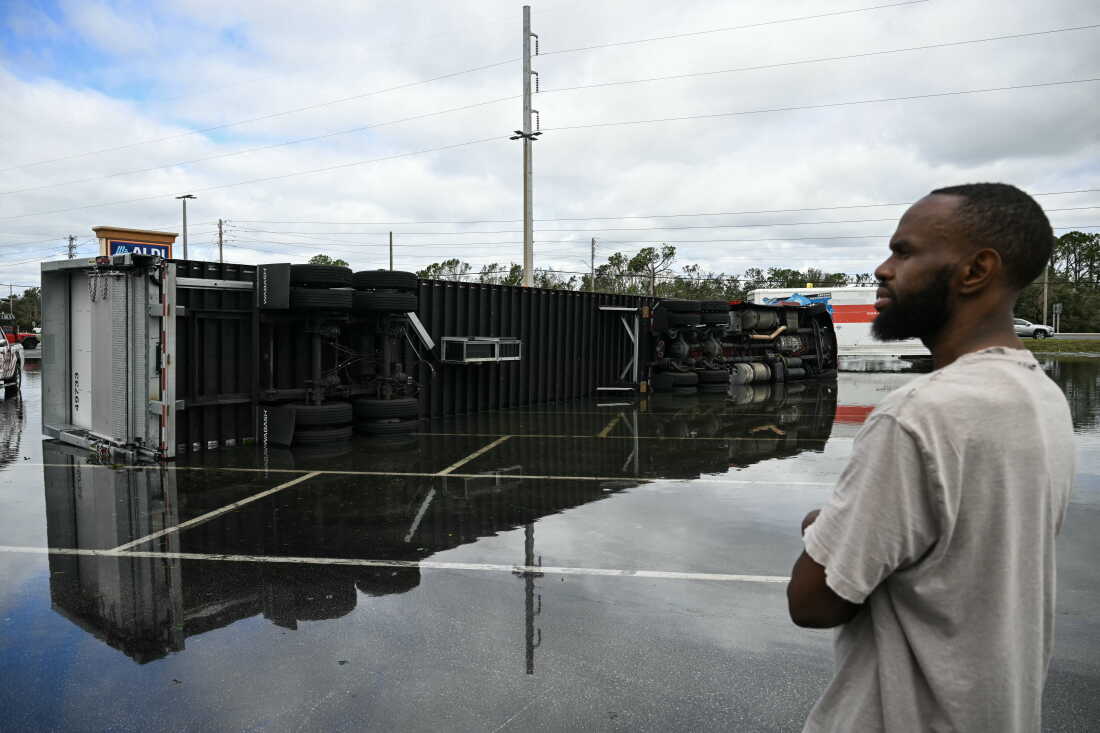
On Saturday morning, a driver surveyed his overturned truck in a flooded parking lot in Tiger Point, Fla., near where Hurricane Isaias had made landfall. Emergency crews in Florida and Alabama are investigating the damage caused by Hurricane Isaias, which hit the Gulf Coast as a Category 2 storm on Friday night. NPR confirmed that at least two people lost their lives due to the storm’s impact.
Isaias brought winds reaching 105 mph, downing trees and cutting off electricity. Officials warn of continued flash flood risks inland. One fatality occurred in Escambia County, in the western part of the Florida Panhandle. Sgt. Melony Peterson of the Escambia County Sheriff’s Office reported that a rescue team found a person trapped under a large tree shortly before 9 p.m. local time on Friday. “The victim was inside the home when the tree collapsed,” Peterson explained via email.
Another storm-related death was confirmed in Jefferson County, Ala., which includes Birmingham. Jim Coker, the Jefferson County Emergency Management Agency Director, told NPR, “We did have a storm-related fatality overnight.” A tree fell on a house, which was a single-family residence, leading to the death.
The hurricane’s force led to the temporary closure of a Waffle House restaurant in Fort Walton Beach, Florida. Isaias made landfall as the first Atlantic hurricane of the season.
As of 11:50 a.m. ET Saturday, around 780,000 power customers in Florida, Alabama, and Georgia remained without power, according to Poweroutage.us. Earlier in the day, this number was closer to 900,000. Florida faced significant outages, especially in counties like Santa Rosa, Holmes, Washington, and Walton. More than 80% of the residents in these areas were without power, as stated by Florida Gov. Ron DeSantis in a morning news conference. “Last night in the wee hours of the morning, those crews began working as early as 3 a.m.,” DeSantis said. Recovery teams also worked on clearing trees that were blocking main roads, with both I-10 and Route 98 open, along with all state bridges.
In Gulf Breeze, Fla., an uprooted tree was observed on Saturday. The southeastern U.S. continued to face a high flooding risk as Isaias, now weakened to a post-tropical cyclone, moved northward.
Isaias landed near Destin, Fla., as a Category 2 hurricane around 8:30 p.m. local time on Friday, with winds reaching 105 mph, according to the National Hurricane Center. The storm surge was approximately 5 feet, not reaching the forecasted 6 to 9 feet, as landfall occurred about two hours before high tide in Destin. Isaias was downgraded to a post-tropical storm a few hours after arriving. By 5 a.m. local time Saturday, its sustained winds had reduced to 35 mph as it moved through Alabama.
The Jefferson County, Ala. emergency management agency tweeted that “multiple trees and power lines are down across the county” and advised residents to “avoid unnecessary travel if possible while crews clear roads and restore service.” The storm’s effects were felt for hundreds of miles. By 9:30 a.m. Saturday, the storm had unleashed a series of powerful thunderstorms through central Georgia. Forecasters warn that the system may generate tornadoes, potentially causing more damage far from the Gulf Coast, as noted by the Florida Public Radio Emergency Network.