
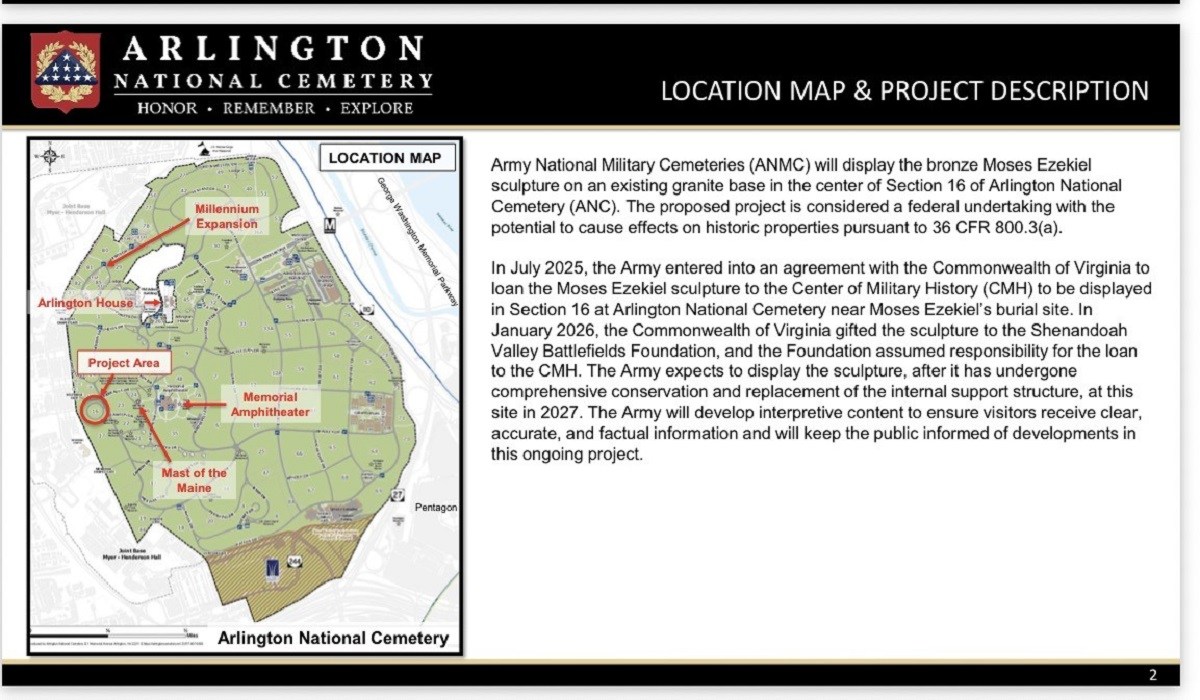
New maps reveal the U.S. Army’s plan to reinstall a disputed Confederate memorial at Arlington National Cemetery, nearly three years after its removal was mandated by Congress. On October 15, the Army presented its final design plans to the U.S. Commission of Fine Arts. These plans outline the intentions to restore and return the bronze sculpture to Section 16 of the cemetery by 2027, according to ABC News.
The proposal details the memorial’s positioning, elevation, and installation. Currently, the Trump administration is progressing towards reversing its removal, which occurred in December 2023. Newsweek reached out to Arlington National Cemetery via email on Sunday for commentary.
What Do the Maps Show?
The Army’s plans specify that the bronze sculpture will return to its original spot in Section 16, where numerous Confederate soldiers are interred. The structure will sit atop the existing granite base, which remained after the bronze elements were removed in December 2023. The Army does not intend to reconstruct the entire monument from scratch.
The design involves conservation and refurbishment efforts before reinstalling the sculpture. Additionally, the Army plans to supply interpretive materials to provide visitors with historical context regarding the memorial and its implications.
The plans were submitted to the Commission of Fine Arts, which advises the federal government on design matters in Washington D.C. The memorial’s return is anticipated in 2027.
Why Was the Confederate Memorial Removed?
In December 2023, the memorial was dismantled in compliance with congressional orders to remove Confederate monuments from military property. The Army stated that it adhered to the congressional mandate and executed the necessary environmental and historic-preservation procedures before removing the bronze elements.
This removal followed suggestions from the Naming Commission, an independent entity created to evaluate military assets honoring the Confederacy. The monument had been at Arlington since 1914. It was crafted by Moses Jacob Ezekiel, a sculptor and Confederate veteran, commissioned by the United Daughters of the Confederacy, and dedicated during President Woodrow Wilson’s tenure.
The monument features a bronze female figure symbolizing the South atop a series of reliefs depicting Southern life during the Civil War. Included among these figures are enslaved Black Americans, representing imagery that has been criticized by historians and detractors arguing that the memorial romanticizes the Confederacy and trivializes slavery.
Why Is the Memorial Coming Back?
The decision to restore the sculpture arises from a policy shift under President Trump’s administration. In 2025, Defense Secretary Pete Hegseth initiated the memorial’s restoration, criticizing its removal as an effort to obliterate American history.
In a social media statement last year, reported by ABC News, Hegseth contended that the Arlington statue “never should have been taken down by woke lemmings. Unlike the Left, we don’t believe in erasing American history; we honor it.”
In July 2025, the Army reached an agreement with Virginia’s Commonwealth to loan the sculpture to the Center for Military History for display at Arlington, near Ezekiel’s burial location.
The Army asserts that the sculpture will undergo thorough conservation and refurbishment before its return. Additionally, it plans to develop interpretive content to provide visitors with precise and accurate historical context.
The restoration has reignited discussions on how the United States commemorates the Civil War and the Confederacy, especially at Arlington, one of the country’s most notable military cemeteries.
Those in favor argue that the monument is a part of national history and should be preserved. Conversely, critics contend that reinstalling it could amplify a cause rooted in sustaining slavery and neglect the experiences of individuals enslaved by the Confederacy.