
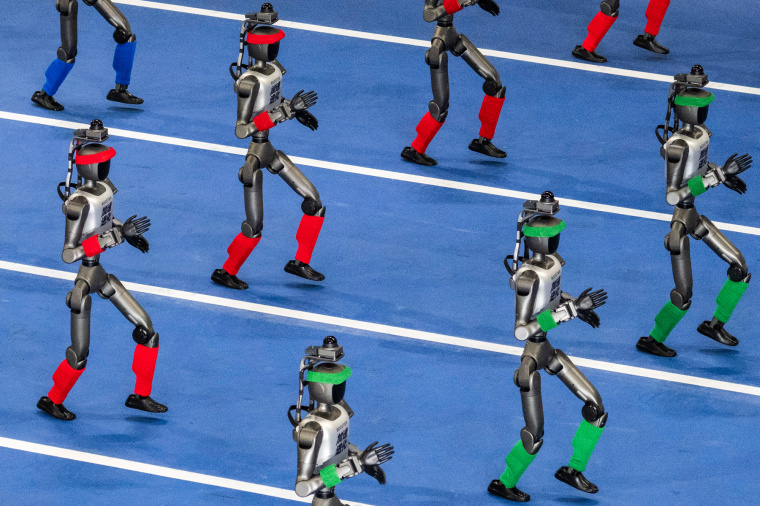
China’s humanoid robots have achieved a significant milestone by surpassing the fastest human speeds. Now, they face a new challenge: handling packaging and warehouse operations while performing precision tasks like connecting cables. These abilities will test the robots’ effectiveness in less glamorous but crucial jobs.
Humanoid Robot Games Overview
The World Humanoid Robot Games commenced in Beijing, lasting for five days. These games blend events mimicking human sports with tests in simulated industrial, restaurant, and emergency situations. With 51 events on the schedule, including 30 sports competitions and 21 scenario-based challenges, more than 40% require robots to function fully autonomously. Huawei, a technology partner for the event, highlighted these details.
In an impressive performance, two robots outpaced Usain Bolt’s 9.58-second world record in the 100-meter race. This marked a drastic improvement from 2025 when the winning robot took over 20 seconds. Despite these advancements, braking remains problematic, with machines crashing into a mat placed beyond the finish line.
Another humanoid matched the champion robot in the 100-meter, completing a 400-meter race in 39.7 seconds, beating Wayde van Niekerk’s record of 43.03 seconds.
The Significance of the Event
According to Xu Qiaosheng, a robotics investor, the increased intensity of the competitions demands better battery management and thermal dissipation. This, he believes, is significant for China’s industrial sector development.
Robots will face off in tug-of-war and weightlifting, as well as Tai Chi and pitch-pot, giving traditional Chinese sports a modern twist.
Beyond the Spectacle: Practical Tests
The more critical tests will see robots dealing with real-world imperfections, such as misaligned cables, distant objects, or shifting packages. These scenarios will test the robots’ ability to identify objects, accurately position themselves, apply force, and recover from errors without human help.
Yu Chao, CEO of Lumos Robotics, stated that while the games may enhance hardware and industry visibility, their true value lies in real-world problem-solving. He emphasized that mere running and jumping do not boost efficiency.
Industry Applications and Future Prospects
In addition to sports events, robots will engage in EV charging, restaurant duties, and emergency incident management. They will also tackle hand-dexterity contests, industrial assembly, and material loading. The cable connection challenge emphasizes vision, alignment, and force control.
Galbot, a Beijing-based startup, plans an automated humanoid tennis match, incorporating ball tracking, serving, and returning shots.
For Hua Rong, CMO at Zeroth, the real competition comes after these demonstrations. She believes that the true test is whether, post-sale, the products consistently address user issues.