
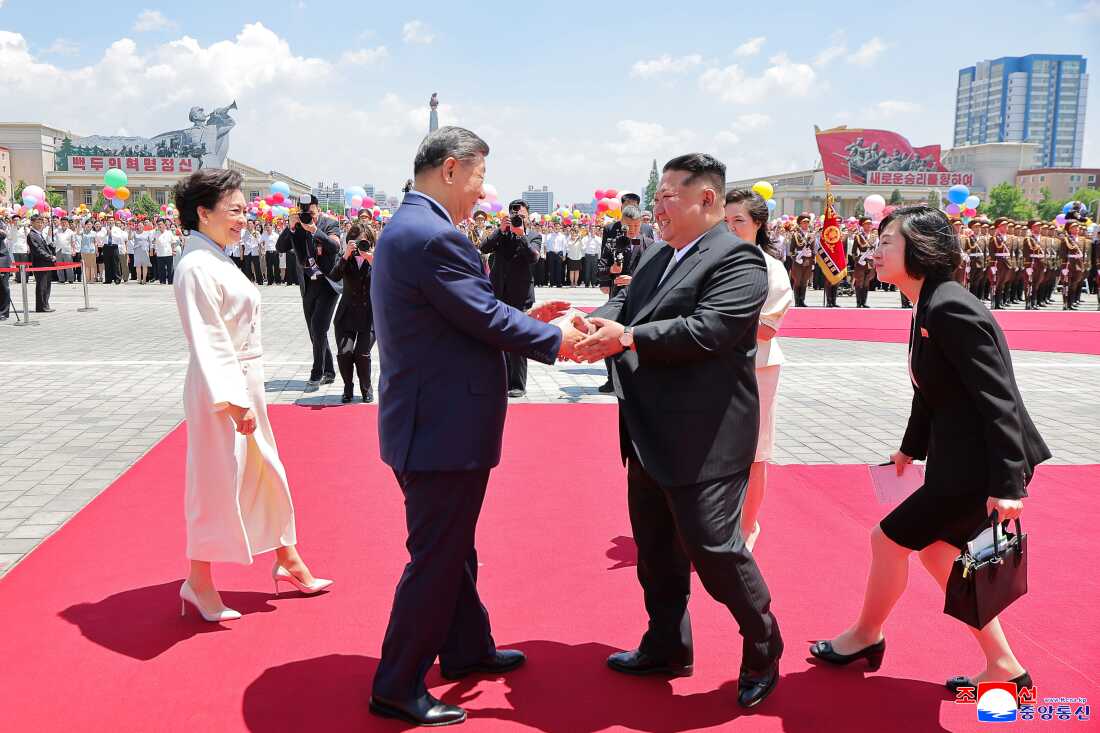
In a photo provided by the North Korean government, Chinese President Xi Jinping is seen shaking hands with North Korean leader Kim Jong Un during a welcome ceremony in Pyongyang. This interaction occurred as the two leaders reaffirmed their alliance, emphasizing strategic cooperation while avoiding public discussion of North Korea’s nuclear weapons program.
Xi Jinping’s two-day visit to North Korea marks his first trip there in nearly seven years. The visit followed a summit with President Trump in Beijing, where both sides reportedly agreed on the shared goal of denuclearizing North Korea. However, Beijing did not publicly affirm this claim, and Xi made no reference to denuclearization during his stay in Pyongyang. According to Chinese state media, Xi emphasized China’s “firm commitment to safeguarding the shared interests of the two countries and preserving a favorable strategic environment.”
North Korea’s state media cited leader Kim Jong Un describing relations with China as “the most important and primary strategic undertaking” for his nation. This suggests that Kim is balancing his relationship between Beijing and Moscow, notably after drawing closer to Russia.
China’s lack of comment on North Korea’s nuclear ambitions coincided with Kim’s efforts to assert North Korea’s status as a nuclear power. Recently, Pyongyang revealed a new nuclear bomb fuel facility, and Kim announced plans to expand the country’s nuclear arsenal “at an exponential rate.” The U.S. views a denuclearized Korean Peninsula as a mutual goal with China, but Beijing has not confirmed this publicly. Kim’s sister dismissed the U.S. claim as “false.”
According to Tong Zhao, a senior fellow at the Carnegie Endowment for International Peace, China’s approach suggests a strategic shift. “China appears to downplay North Korea’s nuclear weapon program to prioritize improving bilateral relations,” Zhao stated. This shift implies a tacit acceptance of a nuclear North Korea and might challenge China’s position if it prompts South Korea and Japan to bolster ties with Washington.
Recently, geopolitical dynamics show China and North Korea aspiring to “expand their alliance relationship beyond the Korean Peninsula.” A street in Pyongyang decorated with the flags of both nations symbolizes this. Earlier, both China and Russia endorsed a “dual track” strategy with the objective of denuclearizing North Korea and replacing the Korean War armistice with a permanent peace regime. However, the global political landscape evolved, especially after Russia’s full-scale invasion of Ukraine brought North Korea into Russia’s sphere as a provider of munitions and troops.
At a 2023 meeting at Camp David under the Biden administration, trilateral political and military cooperation between the U.S., Japan, and South Korea progressed, which China criticized. By 2024, China’s focus shifted towards opposing U.S. sanctions and military pressure on North Korea rather than pursuing denuclearization.
Choo Jaewoo, a foreign policy expert at Kyung Hee University, interprets Xi and Kim’s statements as a reflection of their broader goals. “They would like to expand their alliance relationship beyond the Korean Peninsula,” he explained, potentially involving North Korea in regional conflicts, such as those surrounding Taiwan. This week, both sides agreed on enhancing exchanges, including military cooperation.
Some speculate about a new alliance between China, Russia, Iran, and North Korea, referred to as “CRINK.” However, Seong-hyon Lee from Harvard University’s Asia Center suggests that this arrangement remains more transactional than formal. “This does not require a formal alliance,” Lee mentioned, emphasizing a “loose alignment.”
While China and North Korea discuss strengthening their longstanding alliance, the U.S. and South Korea explore “alliance modernization” and “strategic flexibility.” These talks propose that South Korean forces take the lead in deterring North Korea, allowing U.S. forces to focus on China.
NPR contributors Se Eun Gong from Seoul and Jasmine Ling from Beijing provided additional insights for this report.