
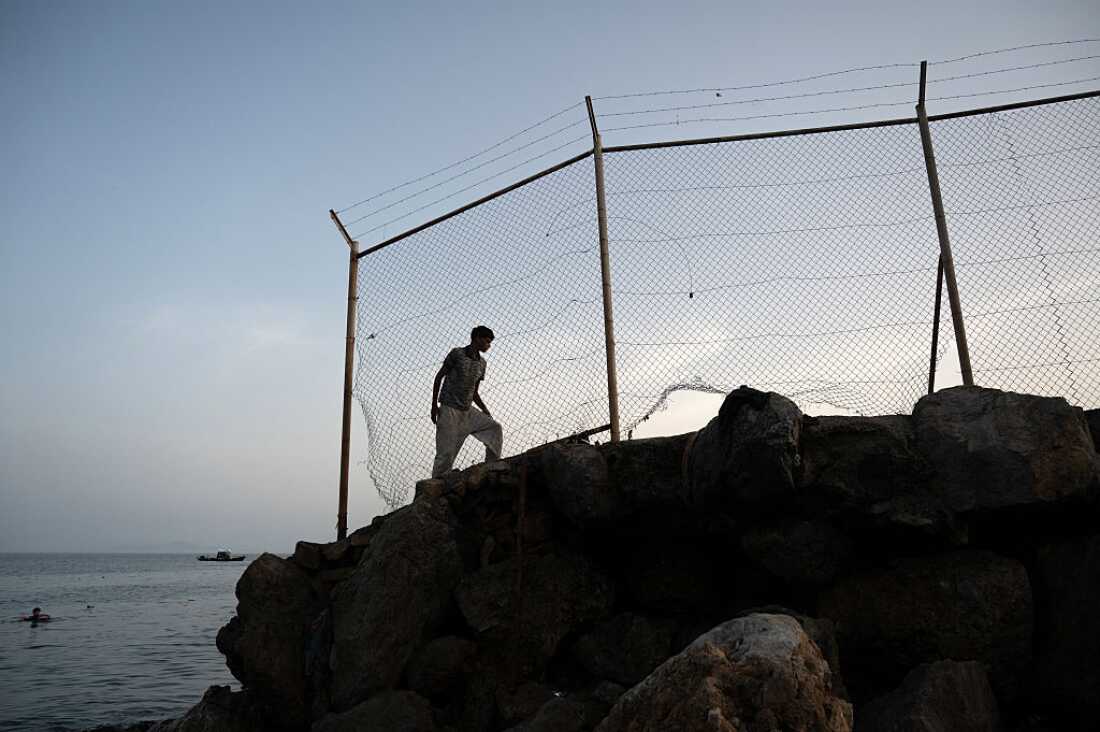
A migrant walks along a rocky shoreline near the border with Morocco after swimming towards Spain’s North African enclave of Ceuta on July 31, 2026. This image captures a moment within a complex situation unfolding at the Spanish-Moroccan border, which has become a focal point for international attention and political discourse.
Spanish Government’s Response to the Crisis
Pedro Sánchez, Spain’s Prime Minister, addressed the media in Ceuta, reiterating his practiced approach to managing media narratives in crises. The Spanish government took swift action, declaring control over the situation by mobilizing the army and installing a floating barrier. Despite these measures, global awareness of thousands of migrants crossing from Morocco persisted.
U.S. President Trump labeled the crossings a ‘catastrophe’ and an ‘invasion,’ criticizing Spain’s immigration laws. Concurrently, Italy’s Prime Minister Giorgia Meloni called it a ‘threat’ to European security and reactivated border controls temporarily.
Internal Political Pressure
Sánchez faced challenges from his political opponents within Spain. The far-right VOX party advocated for militarization and mass deportations. The center-right Partido Popular urged the government to declare a national emergency and close borders.
The crisis occurred amid ongoing wildfire management, adding strain to Sánchez’s government. His adept handling of previous crises has become a notable aspect of his leadership, often remarked upon by citizens.
Causes and Dynamics of Migration
The surge began moderately but escalated into a full-blown crisis as thousands crossed into Ceuta. Reports indicate at least 67 deaths from drowning. Past similar episodes in Ceuta have often involved communal attempts at crossing.
This time, most migrants were Moroccan, with allegations that Moroccan law enforcement was inactive or possibly collusive during peak migration hours. Riccardo Fabiani, of the International Crisis Group, described the event as a ‘manufactured crisis,’ citing evidence of organized transport on the Moroccan side.
Morocco’s ambassador to Spain emphasized their preference for legal migration, without detailing motivations behind the crossings.
Legal and Social Media Influences
A Spanish Supreme Court decision on July 8, which eased deportation rules for swimmers entering Ceuta and Melilla, might have contributed. Social media played a role by spreading messages about border crossing ease.
Historical Tensions Over Ceuta and Melilla
Ceuta and Melilla have been contentious for Spain and Morocco, with the latter historically disputing Spanish control. Tensions increased in 2021 after Spain granted entry to Brahim Ghali for medical reasons. The Polisario Front, led by Ghali, advocates Western Sahara’s independence, which Morocco opposes.
In 2022, Spain endorsed Morocco’s claims, likely aiming to ease diplomatic relations. However, Sánchez also visited Morocco’s rival, Algeria, shortly before Ceuta’s crisis.
International Reactions and Accusations
President Trump’s swift comments and similar sentiments from Israeli politicians led to accusations from Spanish figures about U.S. and Israel exploiting the situation. Antonio Maíllo of Izquierda Unida suggested punitive measures from Morocco tied to geopolitical tensions.
Relations between Spain and Israel remain strained, linked partly to Spain’s vocal opposition to Israel’s actions in Gaza. Discord with the U.S. also persists, following disputes over military spending and base usage.
European Right-Wing Reaction
The migrant surge has galvanized right-wing European figures, prompting Italy to tighten border controls. The European Union, at Italy’s initiative, called for discussions on broad security measures.
Danish Prime Minister Mette Frederiksen joined calls for suspending Schengen cooperation with Spain, citing migration threats.
Sánchez’s stance favors regulated migration, backed by efforts to reduce illegal entries. Spain has invested in coastal patrol initiatives in West Africa. A recent government policy also granted residency to numerous undocumented migrants.
Sánchez advocates for balanced migration policies, attributing economic growth partly to this approach. Despite political challenges, his leadership’s endurance and approach remain pivotal as new pressures emerge.