
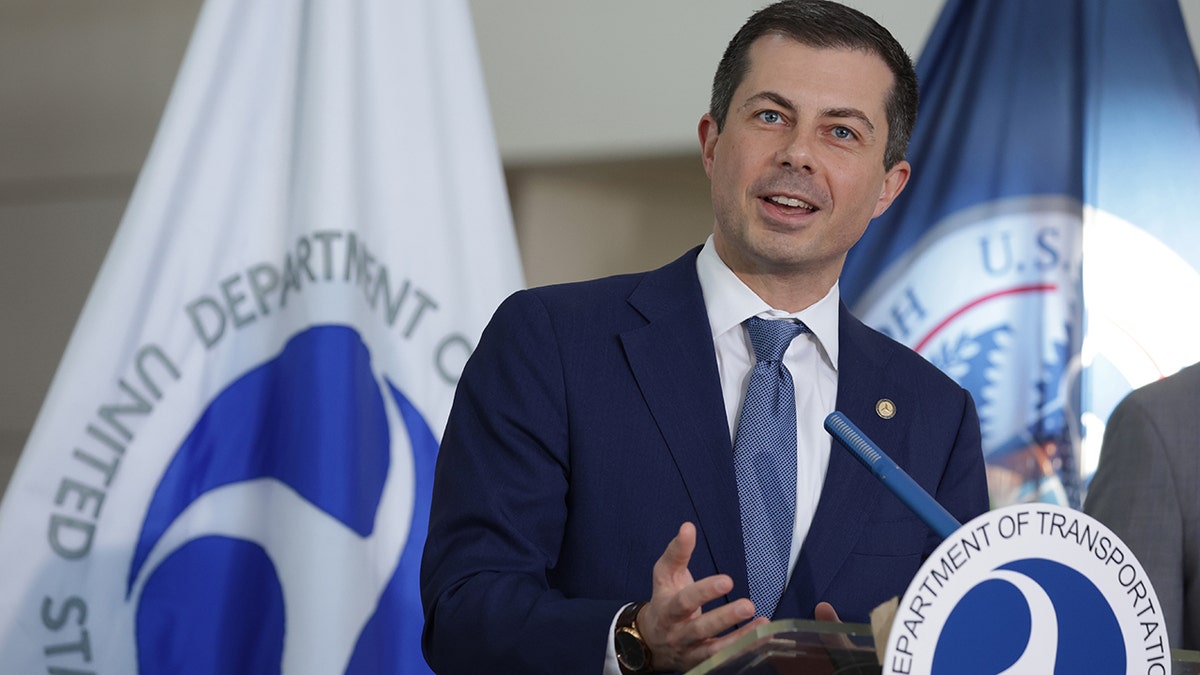
Presidential hopeful Pete Buttigieg attempted to gain attention and address his political record by commenting on the recent airline ground stop. This effort did not resonate well. Despite his aspirations for the 2028 presidential race, Buttigieg ranks fifth among Democratic candidates, largely due to his controversial track record as Secretary of Transportation.
His public critique of Transportation Secretary Sean Duffy’s handling of the airport shutdown did not yield the hoped-for results. Buttigieg held a press conference expressing his concern about the national airspace situation, but admitted lacking inside knowledge. This made his remarks appear ineffective. Buttigieg’s criticism of Duffy inadvertently drew attention to his own past issues in the same role.
His term as Secretary of Transportation is often remembered for his absence during critical moments, such as an eight-week family leave at a time of a significant supply chain crisis.
This period saw numerous cargo ships waiting at ports and a scarcity of goods approaching the holiday season. Buttigieg was mocked on social media as #WheresPete, outside of his responsibilities while consumer demand soared.
Another notable event during his term was a nationwide ground stop of air travel for around 90 minutes, triggered by a failure in pilot hazard alerts. This incident underscored the need for repairs to the outdated air traffic system, a need Buttigieg did not address.
Secretary Duffy commented on Buttigieg’s performance, highlighting a shortage of air traffic controllers stemming from lowered training standards in pursuit of diversity. Under Duffy, staffing improved significantly, with the FAA reporting a record number of hires.
Buttigieg’s tenure included diversity-focused hiring at the FAA, which was met with criticism for prioritizing inclusiveness over qualifications. This initiative could be scrutinized if Buttigieg chooses to run for political office again.
Furthermore, questions remain about the slow rollout of a $7.5 billion electric vehicle charging station initiative. Despite intentions to support a network of chargers, federal bureaucracy and state permitting have delayed progress; only a few stations were operational more than two years after the infrastructure law passed.
Buttigieg’s efforts to enhance racial equity in highway construction also sparked debate, notably tagged as a politicized policy move by opponents.
In response to infrastructure critiques, Buttigieg stated in a recent appearance that his administration worked to upgrade systems without blaming predecessors. However, reports indicate minimal progress on modernizing critical FAA systems, leaving current officials to address outdated infrastructures.
Performance, rather than politics, remains the focus. Unfortunately for Buttigieg, his record may hinder his political ambitions.