
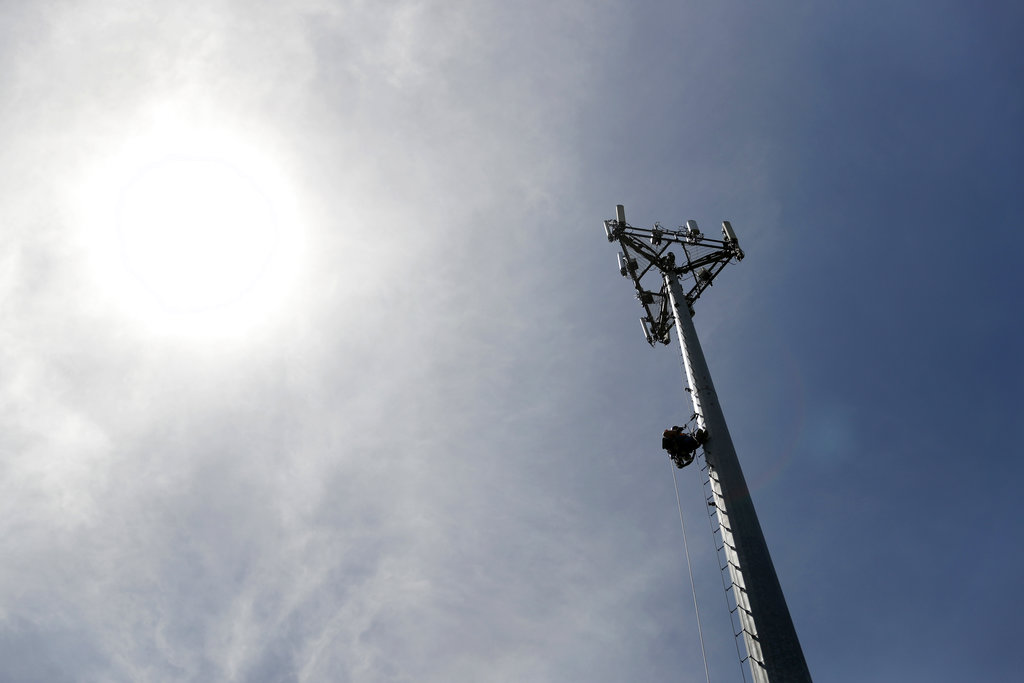
Nick Blase, working with True North Management Services, was seen climbing a cellular phone tower for maintenance in High Ridge, Mo. on May 22, 2017, highlighting ongoing efforts to maintain network infrastructure. A recent report by the Federal Communications Commission (FCC) exposed a paradox in America’s cellular networks. Despite 95% of the population having access to 5G service from at least one carrier, only 69% of the nation’s road miles and 39% of its land area are covered. In rural areas, the figures drop to 60% and 38%, respectively.
The Rural-Mobile Divide
This gap reflects the rural-mobile divide. It focuses not on broadband availability at home but on losing mobile service while on the move or in emergencies. The typical solution is building more cell towers. However, extending networks to all remote locations would be cost-prohibitive. To address this, the FCC plans to allocate up to $9 billion to close gaps in 5G coverage. This initiative proposes rethinking the approach to dead zones, potentially situating the last cell towers in space.
Direct-to-Device Satellite Service
Advancements in technology support a new solution: direct-to-device satellite service. This allows compatible cell phones to connect directly to satellites when terrestrial coverage is lacking. Satellites act as cell towers in space, negating the need for special satellite phones or equipment. All three national carriers have embraced this technology. T-Mobile offers this service via Starlink, included in some plans and available at $10 monthly for other users, even those on competing networks. AT&T and Verizon have established similar partnerships.
Though direct-to-device satellite service cannot replace terrestrial 5G due to its limited capacity, it offers essential services like messaging and emergency communications. Future developments aim to include voice and more data services. Basic connectivity can transform dead zones, enabling important communications like emergency assistance requests.
Leveraging the 5G Fund for Rural America
The FCC’s 5G Fund for Rural America is a starting point for rapidly deploying satellite services. Conceived in the 2010 National Broadband Plan, the fund offers up to $9 billion over 10 years to support mobile service in costly areas. Current rules focus on conventional 5G speeds, but a direct-to-device tier could subsidize basic mobile coverage, where building towers is uneconomical, allowing carriers to bid competitively.
The FCC could solicit bids for the minimal subsidy required to provide satellite coverage in unserved areas, without charging extra premiums. Carriers would qualify for support only if they meet clear standards for service availability, reliability, and compatibility with popular handsets. This approach advances the Communications Act’s goal of allowing reasonable access to communication services in rural areas comparable to urban areas, at similar rates. “Reasonably comparable” services balance accessibility, affordability, and fiscal responsibility of the Universal Service Fund.
Conclusion
Extending terrestrial networks in difficult terrains would deplete resources. Uncovered areas perpetuate the rural divide, and extra costs burden those frequently encountering dead zones. The FCC requires that 5G Fund recipients offer rural service at rates similar to urban rates. Extending these rules to direct-to-device coverage represents an evolution of universal service policy, continually adapting to network technology and economic changes. Now, the last required cell tower might be spaceborne, facilitated by an authorized federal fund targeting remote, market-unreachable locations.
Blair Levin, previously chief of staff at the FCC, directed the 2010 National Broadband Plan. Larry Downes is the co-author of books on innovation, including “Big Bang Disruption.”