
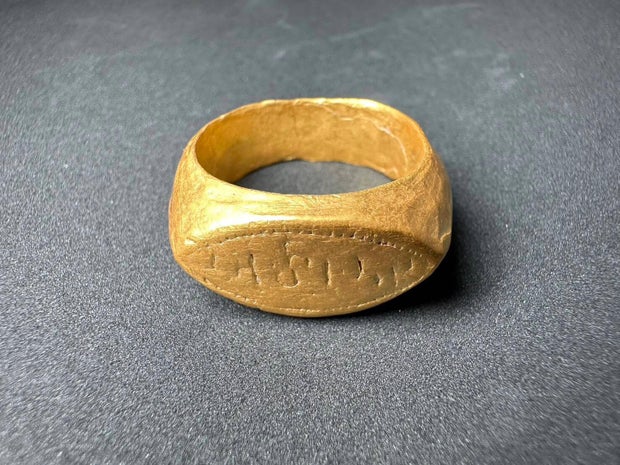
Two gold rings, estimated to be 2,000 years old, were unearthed at a new archaeological site in western Thailand. The find occurred at the Don Yai Thong site in Phetchaburi province, where human remains were also found last week, according to Thailand’s Fine Arts Department.
One of the rings, discovered on a Thursday, features engravings in Bhrami script, a writing system from ancient India. Experts identified the script as ‘pusarakhitasa,’ meaning ‘the one protected by Pushya,’ a notable zodiac sign in Indian astronomy, the department noted. The second ring is a plain gold band without inscriptions.
Authorities suggest the rings may have belonged to a merchant from the Vaishya caste of ancient India. A photograph released by the Fine Arts Department shows the engraved ring on-site.
The Don Yai Thong archaeological site, located about 80 miles from Bangkok, was identified earlier this year after locals discovered bronze drum fragments in a rice field. The site has been dated to Thailand’s late prehistoric era, known as the Iron Age, spanning 1,500 to 2,500 years ago.
Since February, archaeologists have unearthed eight human skeletons, along with various artifacts, such as bronze and gold jewelry and pottery, suggesting ceremonial burials of affluent individuals. Reports indicate one skeleton may belong to a young child, with a bronze object positioned on the torso. Charcoal samples have been sent to the United States for scientific analysis to determine age.
The excavation is set to conclude in a month, with plans to exhibit the findings to the public. A video shared by the Fine Arts Department shows archaeologists working with artifacts and bones at the site.