
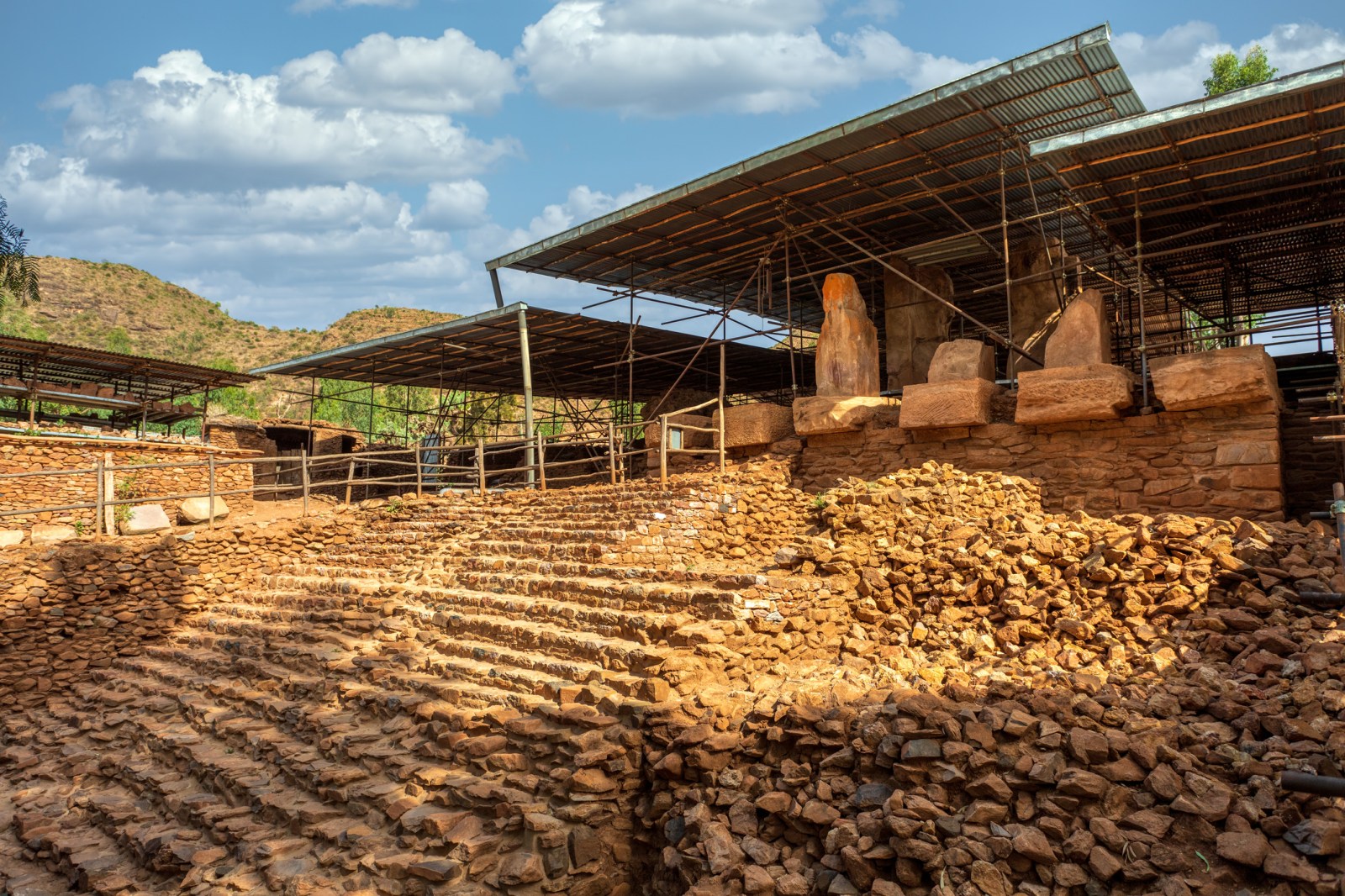
New research has uncovered fascinating insights into an ancient palace in Ethiopia. Dating back around 2,800 years, the Grat Be’al Gibri palace in the Ethiopian-Eritrean highlands is believed to have “reached skyscraper proportions.” This study, led by the German Archaeological Institute and Brandenburg University of Technology Cottbus-Senftenberg, focused on assessing the palace’s architectural innovations.
The palace complex was the largest known of its time in South Arabia and East Africa. It covered a floor area measuring about 60 meters by 60 meters, roughly equivalent to over 196 feet. Despite being destroyed by fire in antiquity, remnants of the ground floor and podium offer clues into its construction techniques.
The building employed rubble masonry with clay mortar, enhanced by horizontal timber beams. Professor Davide Tanasi, from the University of South Florida, emphasized the importance of these construction methods. In a study utilizing virtual 3D models and finite element method analysis, researchers assessed the load-bearing capacity of specific wall sections.
Findings confirmed the use of clay walls, timber, and stone, reinforced by wooden beams in a horizontal grid. These simulations demonstrated impressive load-bearing capacity, suggesting the structural sophistication of local builders. Historian Kwasi Konadu noted that ancient architectural systems were more advanced than their surviving portions imply.
Previous accounts referenced multi-floor structures in ancient texts and art, yet lacked substantiation through engineering analysis. This new research offers “a quantitative assessment” of these systems, highlighting their complex nature. The palace’s walls could theoretically support up to 19 floors, challenging prior assumptions about construction capabilities in the ancient world.
Although Tanasi and Konadu caution against labeling the palace a “skyscraper” in modern terms, they acknowledge its noteworthy design and contribution to re-evaluating ancient engineering narratives. Konadu highlighted the study’s challenge to prior narratives that credited Arabian sources for construction techniques in northern Africa.
The research affirms the expertise of ancient African builders in calculating height, material, and load across centuries. Discussions about advanced engineering often centered on regions like Egypt and Greece. Tanasi emphasized that Yeha demonstrates sophisticated engineering traditions existing within the Ethio-Sabaean region.
The application of modern engineering methods, like numerical simulation, to ancient structures underscored their continued relevance and effectiveness. Lead researcher Martin Drieschner noted their success in applying modern techniques to a 2,800-year-old palace, highlighting the universality of engineering principles.