
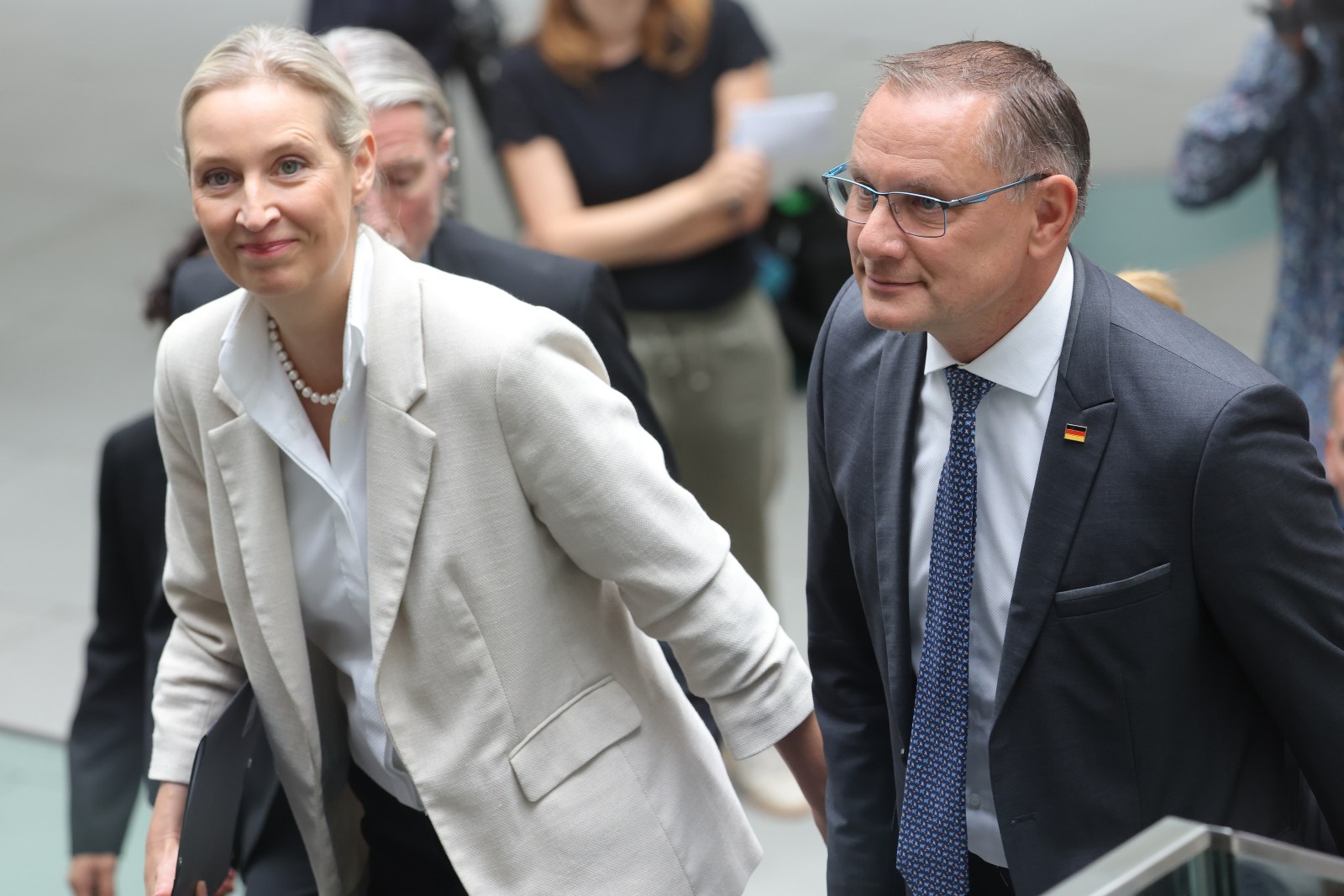
The far-right Alternative for Germany (AfD) party holds strong momentum after its recent success in Saxony-Anhalt, setting a promising outlook for upcoming state elections. In Saxony-Anhalt, the AfD secured 44 percent of the vote, substantially surpassing the 17 percent obtained by the Christian Democratic Union (CDU), the party of German Chancellor Friedrich Merz.
Next, the AfD targets the elections in Mecklenburg-Western Pomerania and Berlin, scheduled for September 20. The party is currently leading polling in Mecklenburg-Western Pomerania, where prediction markets estimate an over 80 percent likelihood of the AfD emerging as the largest party, despite a more competitive environment in Berlin.
“The AfD realized the best score of any party in any German state election during the past ten years,” noted Louis Perron, a Swiss political scientist and consultant.
Elections in Mecklenburg-Western Pomerania and Berlin
In German state politics, the dominant party typically receives an opportunity to form a governing coalition, generally heading it with the state prime minister. However, other major parties often implement a “firewall” strategy, refusing to partner with the AfD to prevent its rise to power.
In Saxony-Anhalt, the far-left BSW (Bündnis Sarah Wagenknecht) party, which garnered 5 percent of the vote, expressed interest in acting as a kingmaker, potentially paving the way for AfD candidate Ulrich Siegmund to become the first far-right state government leader since World War II.
Mecklenburg-Western Pomerania, a coastal state in northeastern Germany, sees AfD leading recent surveys. The state’s legislative chamber requires 36 seats for a majority out of a total 71.
“The situation in Mecklenburg-Western Pomerania is quite different from Saxony-Anhalt,” said Perron. “Germany is a deeply divided country. Each faction believes they must save the nation from the other, leading other parties to mobilize their supporters using Saxony-Anhalt’s result as a rallying cry against the AfD.”
PolitPro data indicates that, as of September 6, 35 percent of respondents favor AfD. The SPD follows with 30 percent support, Die Linke with 11 percent, the CDU with 9 percent, Grüne with 5 percent, and BSW with 4 percent. Remaining parties collectively have 5.1 percent. This data suggests the current SPD and Die Linke coalition could only amass 45.1 percent of the seats, insufficient for a majority.
Polling firm Insa reported AfD’s average support at a slightly lower 30 percent, with the SPD at 23.2 percent and CDU at 15.8 percent. BSW and Linke register at 10 percent and 9 percent, respectively. Prediction markets such as Polymarket and Kalshi forecast AfD as the likely largest party with probabilities exceeding 79 percent.
Berlin
Berlin voters also participate in elections on September 20. As a city-state within Germany’s 16 federal states, its elected chamber governs municipal affairs and represents the capital in the Bundesrat. A minimum of 130 seats are available, requiring 66 for a majority, although the total may increase due to overhang and leveling seats, reaching 159 in the 2023 parliament.
PolitPro’s consolidated summer polling data shows a fragmented landscape, with CDU marginally leading, followed closely by multiple parties, creating no clear two-party coalition outcome.
According to September 6 data aggregation, Die Linke holds 19.8 percent support. CDU comes in at 19.6 percent with AfD at 17.9 percent, followed by Grüne at 16.1 percent, SPD at 12.9 percent, and BSW at 3.6 percent.
Polymarket predicts a 45 percent probability of a Die Linke victory, trailed by CDU at 32 percent and AfD at 17 percent. Leading figures include Steffen Krach for the SPD, Bettina Jarasch and Werner Graf for the Greens, Elif Eralp for Die Linke, and Kristin Brinker for the AfD.
Perron remarked that AfD’s Saxony-Anhalt success “might aid the left in rallying against the AfD,” adding that Chancellor Merz is likely engaged in emergency discussions behind the scenes as elections approach.