
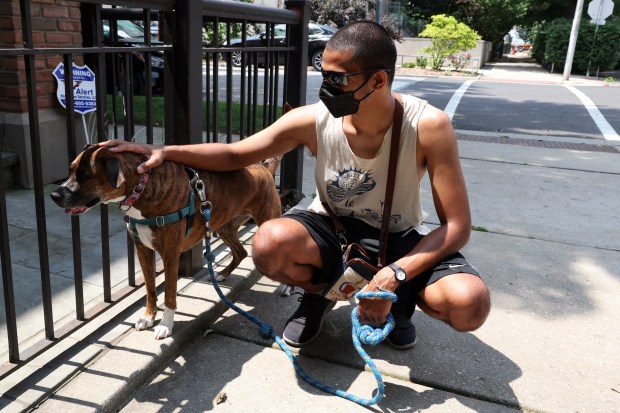
Mike Russell, co-owner of J&M Dog Walking, monitors the weather closely due to its impact on dog walking sessions. When he saw the air quality advisory on Thursday morning, Russell instructed his walkers to limit outdoor time for the dogs and instead spend more time indoors. He quickly realized the pollution was more significant when many North Side clients canceled their dog’s scheduled walks, worried about the health effects of the polluted air.
The comparison of the air to smoking multiple cigarettes was concerning for Russell. “A dog has never smoked a cigarette,” he remarked. Experts point out that hazardous air quality affects not only humans. Fine particles, PM2.5, originating from wildfires in Minnesota and Canada, played a significant role in elevating air quality concerns. Animal caretakers were alert, considering the potential harmful or deadly effects of PM2.5.
These fine particles can irritate the eyes and nose initially. However, due to their small size, they can penetrate deep into the lungs and enter the bloodstream. Shravan Raghuram, another walker at J&M Dog Walking, wore a face mask during his work in the Bucktown neighborhood of Chicago as a precaution against the city’s wildfire smoke.
At Lincoln Park Zoo, general curator Dave Bernier noted that employees closely monitored animals for signs like labored breathing or changes in activity. He emphasized that no animals lost outdoor access due to air quality concerns. Bernier mentioned that keeping certain animals indoors might be more stressful than the poor air quality itself. The main adjustment involved the animals’ feeding habits. Typically, zoo staff mimic foraging by scattering food around habitats. However, on Thursday, to minimize stress, feeding was simplified and more food was dispersed indoors.
Bernier highlighted the importance of monitoring animals closely and urged pet owners to do the same at home. Observations should include watching for increased panting or changes in activity levels. On Thursday, the presence of PM2.5 quadrupled previous air quality records for Cook County, according to the U.S. Environmental Protection Agency data. AirNow labeled air quality levels as “emergency conditions,” affecting everyone. Although conditions improved on Friday, the National Weather Service extended an air quality alert through Saturday.
Jana Kinsman, a beekeeper from Back of the Yards, mentioned how pollution affects her market operations. Due to health concerns brought by smoke and heat, she found it difficult to care for her bees. “I can’t go out and manage my hives,” Kinsman noted. She worried about the stress bees might face from smoke and particulate matter.
Jessica Helgen, University of Minnesota Bee Squad program director, stated that bees can survive smoky conditions, but long-term health impacts from air pollution are less understood. Helgen distinguished between honeybees, considered “managed livestock animals,” and native bees. Honeybees can be relocated when an area becomes unsuitable, but native bees lack that protection. Despite the smoke in Minnesota, bees continued to forage.