
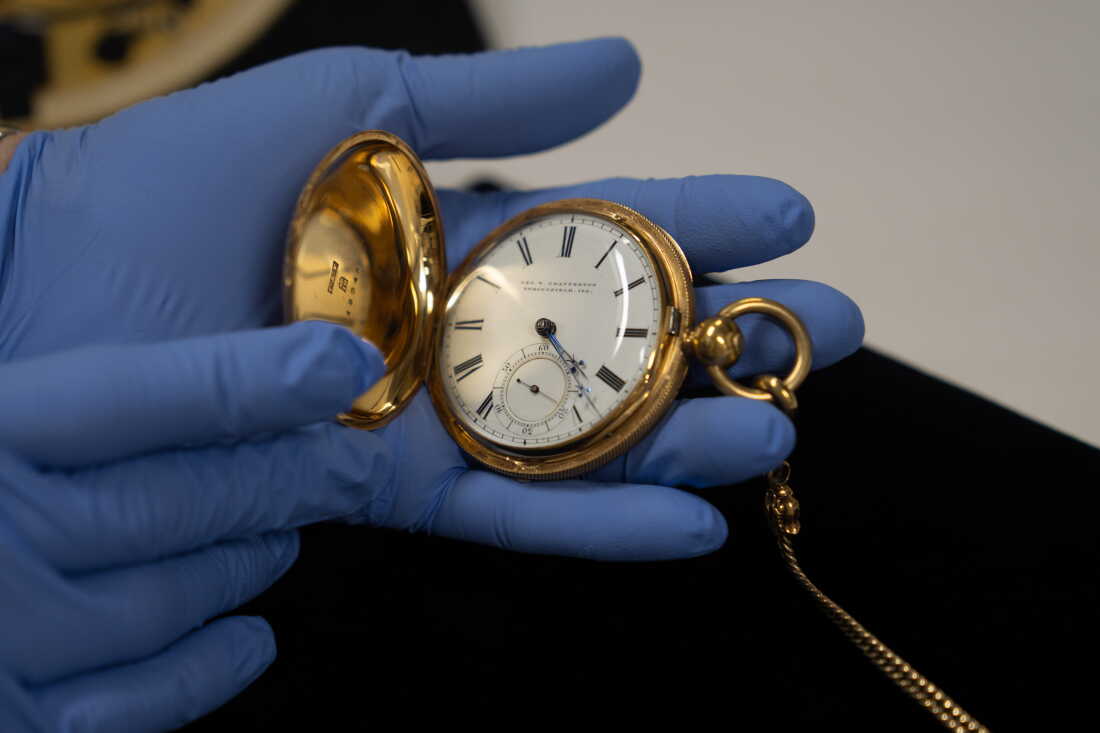
An English-made pocket watch, over 150 years old, resides in the Smithsonian National Museum of American History. This watch, once owned by Abraham Lincoln, is currently kept out of public view within the museum’s extensive collection.
Lisa Kathleen Graddy, curator of American political history at the Smithsonian, shares that Lincoln purchased the watch in the 1850s to celebrate his professional success. Graddy describes it as a personal testament to Lincoln’s transition from a day laborer to a successful lawyer and a future president.
On April 13, 1861, this watch was under repair by Jonathan Dillon, a watchmaker. As Dillon worked, news arrived that the Confederate Army had attacked Fort Sumter in South Carolina, marking the beginning of the U.S. Civil War. According to family lore passed down through generations, Dillon inscribed a secret message inside the watch to commemorate this event.
In 2009, Dillon’s great-great grandson, Doug Stiles, approached the Smithsonian with this story. With curiosity about the authenticity of Dillon’s message, the Smithsonian decided to investigate. Present during this examination was NPR.
Dillon did commemorate the event with an inscription noting the attack, the date the news had reached him and his own name. He also inscribed ‘thank God we have a government.’
To the surprise of historians and Dillon’s descendants, additional inscriptions were found inside. The name L.E. Gross, another watchmaker, was discovered, as well as an inscription stating “Jeff Davis,” likely referring to Jefferson Davis, president of the Confederate States of America.
Graddy suggests that while “Davis” might have been written as a joke or a show of support for the Confederacy, it reflects a broader narrative in American life. She highlights how individuals often express their views and communicate with leaders indirectly, even when direct acknowledgment seems impossible.
Graddy finds Dillon’s message particularly moving, calling it a poignant expression of faith in America. She emphasizes its emotional impact on her, explaining it offers inspiration, especially during difficult times.