
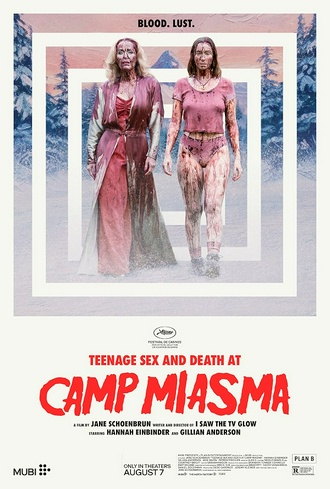
The opening credits of “Teenage Sex and Death at Camp Miasma” unfold a narrative. The story begins with a 1980s teen slasher film, “Camp Miasma,” which gained immense popularity, leading to a series of sequels. Some sequels were released directly to video, along with merchandise like character trading cards and arcade games. It achieved cult status characterized by devoted fans and even a failed Quibi adaptation. Eventually, the film underwent critical re-evaluation termed as a ‘problematic classic’ due to its portrayal of trans characters and teenage sexuality.
The next chapter reveals the studio’s decision to reboot the franchise, enlisting a ‘Sundance wunderkind’ director named Kris for the task. Known for their queer identity, Kris faces the challenge of navigating the franchise’s legacy. This trajectory mirrors the path of other slasher horror series that influenced millennial imaginations, such as the “Sleepaway Camp” series and “Friday the 13th.” Filmmakers often grapple with the genre’s portrayal of sex, race, and gender stereotypes or transphobic elements, feeling conflicted while acknowledging their influence on personal identity.
Director Jane Schoenbrun excels in storytelling that resonates with those molded by media during formative years. Their earlier work, “I Saw the TV Glow,” draws parallels between trans identity and obsessions with long-running TV series indicative of older millennial experiences. Series like “Buffy the Vampire Slayer” and “The X-Files” serve as examples. Preceding this, “We’re All Going to the World’s Fair” delves into internet memes from less corporate eras compared to today’s influencer-centric web.
With “Teenage Sex and Death at Camp Miasma,” the narrative shifts to big-screen entertainment. Kris, played by Hannah Einbinder, recognizes her role to address the franchise’s L.G.B.T.Q. representation issues. Her approach involves intellectual exploration of “Camp Miasma” and horror genres, sometimes masking complex emotions. Kris’ Sundance project, “Jouissance,” notably reimagines “Psycho” from a shower curtain’s perspective. Her strategy leads her to Billy, portrayed by Gillian Anderson, partly chosen for her iconic queer status. Billy was the final girl in the original film and now lives secluded where the film was shot. Kris hopes Billy will contribute to the reboot or shed light on the film series her adolescence was fascinated by, especially Billy’s expression in a pivotal sex scene.