
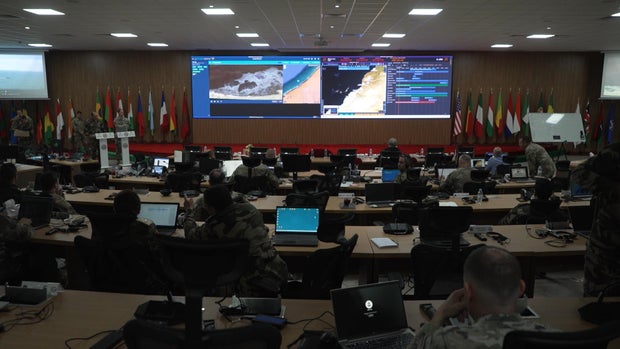
In the arid landscapes of southern Morocco, where the Sahara Desert meets the Atlantic Ocean, a significant military exercise took place this month. The multi-national African Lion 2026 exercise, led by the United States and involving 30 partner nations, showcased advanced military strategies and technologies. Traditional war practices were combined with cutting-edge innovations in artificial intelligence.
AI in Warfare: A New Frontier
The exercise aimed to prepare for the future of warfare, which increasingly leans towards AI-driven tools. American forces demonstrated a range of AI-powered systems designed to enhance operational efficiency. Among these was the noteworthy use of AI to shorten the “kill chain,” which is the process of identifying and neutralizing targets. Implementing AI allowed decisions that once took hours to be made in just minutes.
U.S. Army Lt. Col. Ramon Leonguerrero highlighted the use of an AI platform developed by Palantir. This platform enabled rapid decision-making by processing large volumes of battlefield data, prioritizing information for commanders, and thereby improving response times. In the joint operations center in Agadir, operators monitored and coordinated the exercise using this AI-driven system known as Project Maven.
Project Maven and Anthropic’s Involvement
Project Maven is a flagship initiative of the Pentagon, created to harness AI for analyzing battlefield data. A key component of its functionality is the integration with Anthropic’s Claude large language model. This software allows military operators to interact with extensive battlefield intelligence using simple queries in English. Despite recent tensions between Anthropic and the U.S. Defense Department over ethical concerns, the exercise affirmed Anthropic’s continued role in military AI systems.
The Debate on Autonomous Decision-Making
Despite advancements, the ethical dimensions of AI in warfare are hotly debated. The idea of machines making autonomous lethal decisions raises concerns. A U.S. soldier expressed unease about delegating critical decisions to machines, emphasizing the importance of human judgment in warfare. Although Defense Secretary Pete Hegseth reassured that AI wouldn’t make battlefield decisions, there are ongoing discussions about the potential and limits of AI autonomy in military operations.
AI Enhancing Combat Safety
One of the practical applications of AI shown during the exercise involved reducing human exposure to risk by replacing soldiers on the front lines with robotic systems. Overland AI, a defense contractor, demonstrated its ULTRA autonomous vehicle. Operated remotely, it maneuvers independently, equipped with weapons capable of engaging threats and assisting in combat operations.
Overland AI’s Director of Business Development, Tim Bishop, explained how ULTRA could provide covering fire, lay mines, and deploy explosives while keeping soldiers safe. Current systems require human input for firing decisions, but future advancements could see ULTRA operating its weapons autonomously.
1st Lt. Vincent Gasparri, leading the innovation team from the 173rd Airborne Brigade, acknowledged the life-saving potential of such technology. He reported that their drill replaced 40 soldiers with just two robots, proving significant in reducing risk and injury on the battlefield.
The underlying goal emphasized by military personnel is the preservation of life. The integration of AI in military operations, despite moral and ethical challenges, is all about enhancing efficiency, quickening decision-making, and ultimately saving lives.