
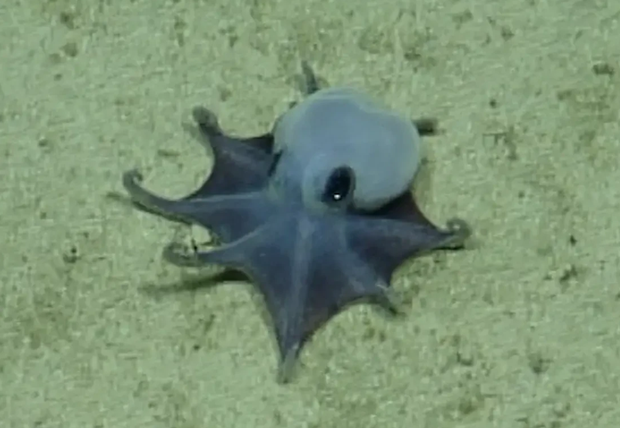
On the ocean floor near the Galapagos Islands, scientists using a submersible found a mysterious octopus. This octopus, as blue as the ocean, could fit in the palm of a hand. An excited scientist exclaimed upon seeing the small, cerulean cephalopod transmitted through footage.
The Charles Darwin Foundation team discovered this new species about 5,900 feet below sea level, as reported in recent research. Octopus expert Janet Voight was asked to identify the species.
Initially, Voight, a curator at Chicago’s Field Museum of Natural History, received photos of the octopus. Later, the preserved specimen arrived by mail. Voight expressed her admiration, “It’s beautiful!”
This new octopus species was found 5,800 feet deep near Isla Darwin. Voight noted its uniqueness, as the closest known octopus of similar shape resides off Uruguay’s coast in a different ocean.
To describe a new octopus species, internal examination is needed, but they had only this one specimen. Instead of dissection, the team used CT scans to create a 3D model, detailing the octopus’s internal structure.
There’s nothing like spending the day looking at something no other human has ever seen,said Stephanie Smith, head of the Field Museum’s X-ray lab.
The new octopus, Microeledone galapagensis, stands out beyond its blue color, which is rare in nature. It appears as a runt of the Megaleledonidae family, known for larger sizes in the Southern Ocean near Antarctica.
Voight highlighted its distinct features like short arms with one row of suckers, and its smooth back. Its back is light blue while its underside is a deep purple, which may help protect it from predators by covering prey that emit light.
Finding new deep-sea octopus species is not unusual, especially in less-explored areas. “If you took all the land on Earth and pieced it together, you would not cover the Pacific Ocean,” Voight added. She last encountered a new species in 2023 off Costa Rica’s coast.
The first sighting occurred in 2015 near Darwin Island, linked to the scientist’s evolutionary studies in the Galapagos. Voight, leading a team officially describing this species, has studied octopus evolution for four decades.
“These are little octopuses that live in the deep sea, and hardly anybody on Earth has ever gotten to see them. I just feel lucky that I got to work with them,” Voight reflected. Her study was published in Zootaxa.
Globally, about 300 octopus species exist in all oceans. In 2024, scientists discovered four new species off Costa Rica.