
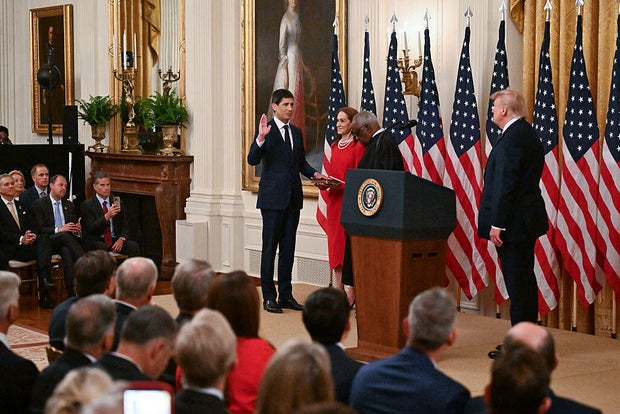
Kevin Warsh was officially sworn in as the chairman of the Federal Reserve, succeeding Jerome Powell. The oath-taking ceremony took place at the White House, where Warsh expressed his commitment to guiding the central bank with a focus on promoting price stability and maximizing employment. He emphasized the importance of using wisdom and clarity to pursue these goals, aiming for lower inflation, stronger growth, and higher real take-home pay to ensure America’s prosperity and security.
Warsh promised to lead a reform-focused Federal Reserve, learning from past experiences and maintaining high standards of integrity and performance. The event, held in the East Room of the White House, was attended by Supreme Court justices, Congress members, Cabinet officials, and business leaders. Justice Clarence Thomas administered the oath, with Warsh’s wife holding the Bible during the ceremony.
President Trump introduced Warsh and expressed his desire for the new Fed chair to operate independently and effectively. Trump has repeatedly urged the Federal Reserve to lower interest rates to boost economic growth, a point not directly addressed in his speech, but he underscored the importance of fostering a thriving economy without unnecessary constraints.
In the past year, Trump has been vocal about his wish for reduced rates, criticizing Powell’s cautious approach. Powell, who led the Fed since 2018, navigated through the COVID-19 pandemic and rising inflation. Despite pressure, Warsh has vowed to keep monetary policy decisions independent of political influence, highlighting a potential collaborative approach with the Trump administration on other economic matters.
The decision-making process regarding interest rates remains complex. Although Warsh can influence the panel as chair, he needs to convince a committee of 12 top Fed officials to implement rate cuts. Currently, inflation rates exceed the Fed’s 2% target, and the Iranian conflict has pushed inflation higher. While employment remains strong, some committee members are skeptical of rate reductions despite labor market concerns.
Financial markets anticipate stable interest rates, with analysts predicting a 70% likelihood that rates will rise by year-end. Interestingly, Powell will continue to have a say on the rate-setting committee as part of the Board of Governors, maintaining a role until the resolution of the Justice Department investigation into his monetary policy actions.
Previously known for favoring tighter monetary policies during his Fed tenure from 2006 to 2011, Warsh recently supported lower rates. He believes technological advancements, like AI, could suppress inflation and boost productivity, a viewpoint that may spark debate within the committee.
Randall Kroszner, a former Fed colleague, believes Warsh will resist short-term political pressures, describing him as a strategic thinker who values consensus to achieve objectives.
Overall, Warsh’s leadership marks a significant transition as the Federal Reserve navigates economic challenges and opportunities.