
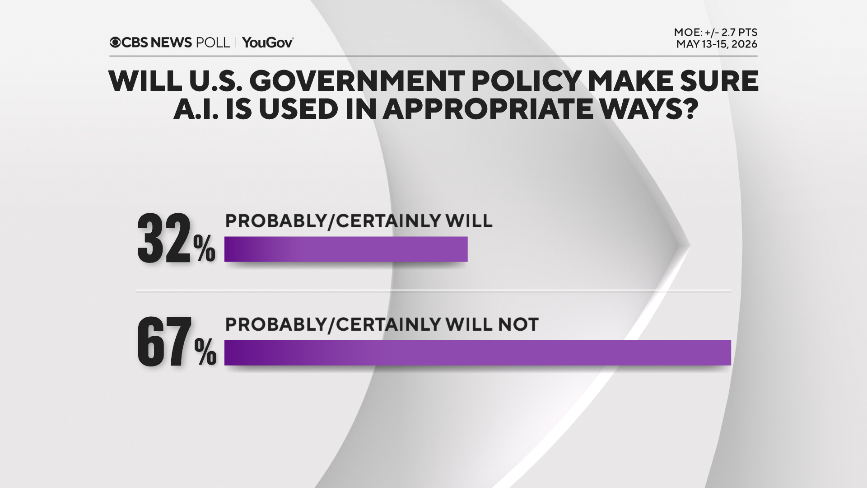
Most Americans believe that artificial intelligence (AI) will decrease the number of jobs in the U.S. This concern extends beyond employment, with doubts about whether the U.S. government will establish effective policies to ensure AI is used responsibly.
Skepticism about government oversight is widespread among different age groups and educational backgrounds. Both Democrats and independents largely doubt government policies will ensure proper AI usage. On the other hand, Republicans show a more divided stance on this issue.
When examining the motivations behind AI promotion, Americans identify several reasons. These include making daily tasks easier and the potential for AI to replace human workers. Two-thirds of the surveyed population think that government policies likely won’t ensure AI is used appropriately. Many who hold this belief are especially concerned about job losses due to AI.
Respondents suspect AI companies aim to increase their own power and replace human workers among their top motives. Although a sizable majority also recognizes the potential for scientific and medical advancements or task simplification, these reasons are seen as less dominant.
AI and Employment Concerns
The viewpoint that AI will lead to job reduction in the U.S. has persisted over the past year. Both young and older Americans foresee job losses as a consequence of AI, though younger individuals are somewhat less pessimistic.
This reduced concern among younger people may be due to their greater familiarity with AI. Previous surveys by CBS News have shown that younger Americans are more likely to use AI and report a better understanding of the technology compared to older generations.
This CBS News/YouGov poll reflects a representative sample of 2,064 U.S. adults interviewed from May 13-15, 2026. The sample was adjusted to reflect national demographics regarding gender, age, race, and education per the U.S. Census American Community Survey and Current Population Survey.
The margin of error for the poll is ±2.7 points.
Poll Methodology
Poll contributors include Anthony Salvanto and Fred Backus. The methodology ensured a nationally representative sample, accounting for variables based on recent U.S. Census data and past presidential voting patterns.